

Did you know that over 500 banks in the United States have failed since 2000, many due to poor risk management and inadequate oversight?
With threats ranging from credit defaults and market volatility to cyberattacks and regulatory non-compliance, banks are exposed to a wide range of risks that can spread quickly and amplify losses across the organization.
As these risks grow in scale and complexity, regulators have tightened requirements, making effective risk management a core priority for banks of all sizes.
In this article, we will explore what risk management in banking is and how to apply it effectively to strengthen resilience and long-term stability.
Key takeaways
- Risk management is both a safeguard and a requirement
Banks manage risk to protect depositors, preserve financial stability, and remain compliant in a highly regulated environment. Strong risk management frameworks are essential to earning trust and ensuring long-term viability.
- Banks face multiple interconnected risk types, not just credit risk
Credit, market, operational, liquidity, compliance, reputational, and strategic risks often amplify one another. Managing them in silos creates blind spots and increases the risk of systemic failure.
- Effective risk management follows a continuous, structured process
The most resilient banks consistently identify, assess, measure, mitigate, and monitor risk. This cycle ensures that emerging threats are caught early and resources are focused where they matter most.
- Modern risk management depends on data, technology, and real-time insight
Integrated platforms, advanced analytics, and real-time monitoring help banks move from reactive controls to proactive prevention. This reduces losses, improves decision-making speed, and lowers operational friction.
- Real-time prevention is the biggest opportunity to strengthen risk management
Traditional frameworks often detect risk after transactions occur. Platforms like VALID enable real-time decisioning at the point of risk, stopping fraud before losses happen, reducing manual reviews, and even transferring covered losses off the balance sheet.
What is risk management in banking?
Risk management in banking is the ongoing process of identifying, evaluating, and reducing the risks that banks face in their daily operations. These risks can come from many sources, such as:
- Loan defaults
- Changes in market conditions
- Cybersecurity threats
- New regulations
Since banks are heavily regulated, effective risk management is not only an internal responsibility but also a legal requirement.
With a strong risk management framework, banks can comply with regulations while protecting depositors’ funds, maintaining investor confidence, and supporting the stability of the financial system.
Types of risks that banks should manage
Banks face a wide array of risk types that can threaten their financial health if not properly managed, such as:
|
Risk type |
Description |
Examples |
How banks manage it |
|
Credit risk |
Risk of loss when borrowers or counterparties fail to meet repayment obligations |
Loan defaults on mortgages or business loans |
Credit assessments, prudent lending standards, collateral requirements, and loan portfolio diversification |
|
Market risk |
Risk of losses due to changes in market prices or rates |
Interest rate changes, foreign exchange fluctuations, and stock or commodity price swings |
Hedging with derivatives, diversification, and exposure limits |
|
Operational risk |
Risk arising from failed internal processes, people, systems, or external events |
Cyber-attacks, IT outages, fraud, human error, or natural disasters |
Strong internal controls, audits, staff training, backup systems, and disaster recovery plans |
|
Liquidity risk |
Risk that a bank cannot meet short-term cash obligations |
Sudden large deposit withdrawals |
Maintaining liquidity buffers, diversified funding sources, contingency funding plans, and regulatory liquidity ratios |
|
Interest rate risk |
Risk to earnings or capital from changes in interest rates |
Fixed-rate assets losing value when interest rates rise |
Asset-liability management, interest rate swaps, and maturity matching of assets and liabilities |
|
Compliance risk |
Risk of legal penalties or reputational damage from regulatory non-compliance |
Violations of AML rules, capital requirements, or consumer protection laws |
Compliance programs, regulatory monitoring, staff training, and internal audits |
|
Reputational risk |
Risk of loss due to negative public perception |
Scandals, regulatory fines, unethical behavior, or data breaches |
Strong ethical culture, transparent communication, and effective crisis management |
|
Strategic risk |
Risk from poor business decisions or failure to adapt to change |
Failed market expansion, mispriced products, or ignored competition |
Strategic planning, governance oversight, scenario analysis, and alignment with risk appetite |
Risk management in banking—A step-by-step process
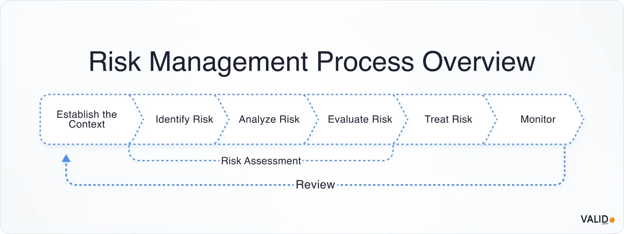
Managing these risks requires a structured and systematic approach. Although specific frameworks may differ, most banks follow a common set of steps to identify, assess, and control risks across the organization.
Step 1: Risk identification
Risk management begins with identifying and documenting all risks the institution may face. Banks analyze activities across departments and products to uncover threats such as credit defaults, market volatility, and operational or technology weaknesses, while also examining the root causes of these risks.
Step 2: Risk assessment
After risks are identified, the bank evaluates how likely each risk is to occur and what the potential impact would be if it did.
This assessment combines quantitative tools, such as statistical models, historical data, and stress testing, with qualitative methods, such as expert judgment and scenario analysis.
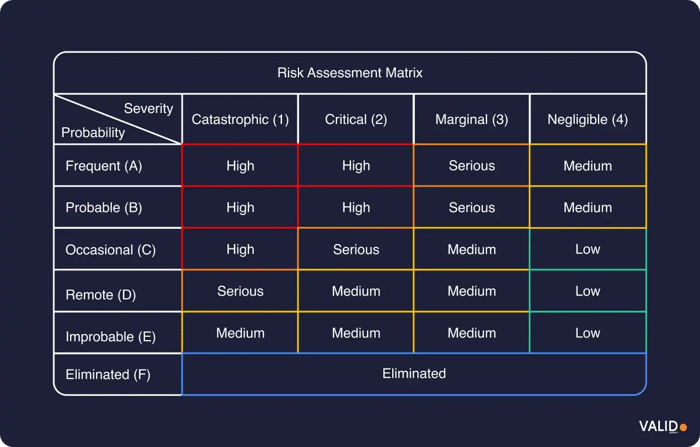
Risks are then scored or ranked by severity, allowing management to prioritize the most significant threats.
Step 3: Risk measurement
For many financial risks, banks move beyond assessment to formally quantify risk numerically. This includes measuring credit risk, including unexpected losses and market risk, using metrics such as Value-at-Risk (VaR).
Quantifying risk helps banks allocate capital appropriately, compare exposures to their risk appetite, and make informed decisions about which risks to accept, reduce, or avoid.
Step 4: Risk mitigation
Once risks are identified, assessed, and measured, banks take steps to control or reduce them through targeted mitigation strategies.
These may include avoiding high-risk activities, reducing exposures, transferring risk (such as through insurance or hedging), or accepting limited risk within defined boundaries.
Step 5: Monitoring and reporting
Banks track key risk indicators and metrics, such as credit delinquencies, market value changes, and liquidity measures, to detect rising risk and trigger timely management action. Regular audits and clear reporting to senior management, the board, and regulators ensure transparency, accountability, and informed decision-making.
Best practices for effective risk management in banking
The following best practices outline how banks can strengthen their risk management capabilities by aligning governance, processes, data, and technology across the organization.
1. Implement an integrated risk management framework
When risks are managed in isolation, important connections can be missed.
Banks are increasingly moving away from siloed risk management and toward integrated, enterprise-wide risk management (ERM) frameworks that provide a complete view of risk across the organization.
Key practices banks should implement:
- Consolidation of risk data from all major risk domains into a centralized system to provide a comprehensive, enterprise-wide view of risk exposure
- Standardized risk assessment methodologies to ensure consistency in how risks are identified, measured, and evaluated across business lines
- Unified risk reporting that enables senior management and the board to clearly compare, prioritize, and address risks across the organization
- Regular enterprise-level risk reviews to evaluate how individual risks combine or amplify one another and to support informed strategic decision-making
2. Establish strong governance and a clearly defined risk appetite
Effective risk management depends on clear leadership, accountability, and oversight. When governance structures and risk boundaries are well defined, risk-taking remains aligned with the bank’s strategy, capacity, and long-term objectives.
How to put this into practice:
- Establish active board and senior management oversight with clearly defined roles, responsibilities, and escalation protocols.
- Develop and approve a formal risk appetite statement that sets measurable limits across key risk categories and guides decision-making at all levels.
- Appoint an independent, empowered Chief Risk Officer (CRO) with authority to challenge business decisions and escalate concerns when risk limits are approached or exceeded.
- Align business strategies, growth initiatives, and new products with the approved risk appetite to prevent excessive or unmanaged risk-taking.
- Tie executive compensation and performance metrics to risk-adjusted outcomes in order to reinforce balanced risk and reward.
3. Leverage technology and data analytics
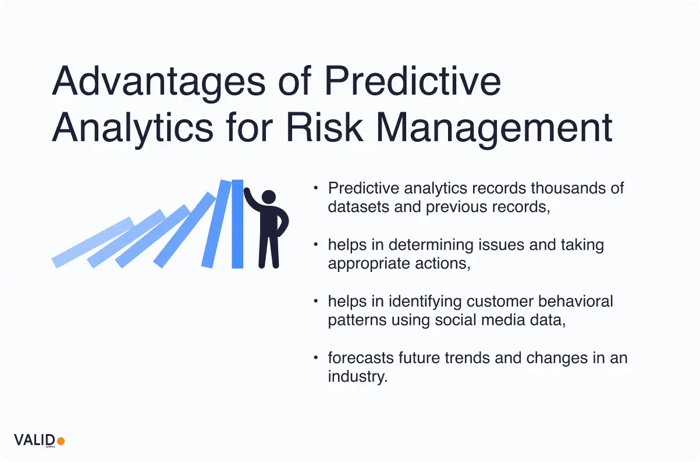
Modern risk management depends on timely, accurate data and the ability to see emerging threats before losses occur.
By using advanced analytics and integrated technology platforms, banks can improve risk visibility, reduce response times, and shift from reactive to proactive risk management.
How to put this into practice:
- Invest in integrated risk management information systems (RMIS) that aggregate data across credit, market, operational, compliance, and fraud risk domains.
- Use real-time dashboards and analytics to provide management with up-to-date views of key risk indicators instead of relying solely on static, periodic reports.
- Apply advanced analytics, including machine learning and predictive models, to identify anomalous transactions, emerging fraud patterns, and early signs of credit deterioration.
- Integrate data from multiple sources (core systems, loan platforms, trading systems, and external market feeds) to improve the accuracy and timeliness of risk assessments.
- Leverage automation and RegTech solutions to support compliance monitoring, such as AML transaction surveillance and regulatory reporting.
- Establish strong model risk management and cybersecurity controls to address new risks introduced by AI, automation, and digital tools.
Worth knowing:
To apply risk management effectively, you need a tool that not only defends systems but also understands behavior, transactions, and risk in real time. That’s where platforms like VALID Systems stand out.
VALID combines real-time machine learning, behavioral risk scoring, and cross-institution intelligence to stop fraud before losses occur. This way, VALID helps financial institutions to:
- Predict and prevent fraud in real time, not just detect it
- Reduce manual reviews and operational friction through ML-driven decisioning
- Strengthen systemic resilience through shared fraud intelligence networks
- Turn risk management into a revenue opportunity via instant funds and opt-in services
- Protect customer trust with faster, safer access to funds
Contact us today and see how VALID transforms real-time risk management into proactive fraud prevention, operational efficiency, and new revenue opportunities.
4. Conduct regular stress testing and scenario analysis
Stress testing allows banks to plan ahead by evaluating how their balance sheet and operations would perform under severe but plausible conditions.
By identifying vulnerabilities before a crisis occurs, management can take proactive steps to strengthen capital, liquidity, and resilience.
How to put this into practice:
- Perform regular stress tests across key risk areas, including credit portfolios, market exposures, liquidity positions, and operational resilience.
- Model a range of adverse scenarios, such as economic downturns, sharp interest rate movements, funding disruptions, or major operational events.
- Use stress test results to identify capital and liquidity shortfalls and take preemptive actions, such as adjusting asset composition or strengthening funding sources.
- Supplement regulatory stress tests (such as CCAR) with internal “what-if” and reverse stress testing to evaluate extreme but plausible failure scenarios.
- Integrate stress testing outcomes into contingency planning, recovery strategies, and risk appetite discussions.
- Update scenarios and assumptions regularly to reflect changing market conditions, emerging risks, and lessons learned from prior results.
Benefits and challenges of risk management in banking
Every bank that invests in a strong risk management program stands to gain numerous benefits. At the same time, implementing risk management is not without challenges, as it can be complex and resource-intensive.
Here are the key pros and cons you should consider:
Benefits:
- Financial stability: A strong risk management program helps keep the bank stable and resilient, even during economic uncertainty. By spotting and reducing risks early, the bank can avoid major losses and protect its overall solvency.
- Efficient capital allocation: Effective risk management ensures capital is used where it delivers the best risk-adjusted returns. By understanding risk levels, banks can avoid tying up capital in overly risky activities while confidently supporting profitable lending and investment opportunities.
- Trust and reputation: Consistent risk discipline builds confidence among customers, regulators, and investors. A reputation for stability and sound judgment can also lower funding costs, reinforcing the bank’s credibility and brand strength.
- Optimized returns: Risk management is about taking smart risks, not avoiding them altogether. By balancing risk and reward, banks can pursue sustainable growth, avoid extreme losses, and achieve steadier, more reliable profitability over time.
- Long-term growth and sustainability: Embedding risk management into everyday decisions supports lasting success. Banks with strong frameworks can expand into new markets, adapt to economic cycles, and seize opportunities with confidence.
Challenges:
- Cybersecurity threats: As banking becomes more digital, cyber and fraud risks continue to grow in scale and sophistication. Banks must constantly invest in security to protect sensitive data and systems.
- Regulatory changes: Banking regulations are continually evolving, making compliance a moving target. Keeping up with new rules requires significant time, expertise, and resources, and even small missteps can result in fines, restrictions, or reputational damage.
- Complex financial products: Innovative financial products can drive revenue but often introduce hard-to-measure risks. Managing these instruments requires specialized skills, advanced models, and strong controls, which can strain a bank’s risk management capabilities.
- Global market uncertainties: Operating across borders exposes banks to geopolitical events, currency swings, and differing regulatory regimes. The challenge is to manage risk consistently while adapting to local conditions and sudden global disruptions.
- Balancing profit and risk: Banks must take risks to grow, but unchecked risk-taking can lead to serious losses. Risk management must carefully rein in excesses without blocking healthy growth, making the alignment of incentives, culture, and oversight a constant balancing act.
Strengthen risk management in banking with VALID
Traditional risk management frameworks help banks set limits, allocate capital, and meet regulatory expectations, but many risks only become visible once transactions are already underway.
Operational and fraud-related risks, in particular, cannot be fully controlled through policies, buffers, or post-event reviews alone.
That is why modern risk management requires shifting from reactive controls to real-time prevention, stopping high-risk activity at the exact moment it is identified.
This is exactly what VALID does.

VALID Systems is a financial technology company specializing in fraud prevention and risk management solutions for banks, financial institutions, and credit unions.
Trusted by top financial institutions processing over $4 trillion in annual check volume, VALID is built for environments where delay, guesswork, and after-the-fact detection are no longer acceptable.
Here is what VALID can do for you:
1. Real-time decisioning at the point of deposit: VALID’s patented Real-Time Loss Alerts (RTLA) and CheckDetect evaluate every deposit instantly across mobile, ATM, and branch channels. Banks can approve, hold, or decline deposits in the moment, eliminating delayed decisions, downstream losses, and unnecessary customer friction.
2. Machine learning that goes beyond the check image: While traditional tools focus heavily on image analysis, VALID evaluates risk using a richer, multidimensional lens, including:
- Behavioral analytics
- Payer–payee relationships
- Transaction context and velocity
- Cross-institution intelligence from the Edge Data Consortium
3. Guaranteed risk protection: VALID doesn’t stop at detection. If a deposit item approved by VALID results in a covered loss, VALID absorbs the loss, effectively removing that operational and financial risk from the bank’s balance sheet.
This approach captures up to 95% of fraud losses while alerting on just 0.5% of items, dramatically reducing false positives and manual reviews.
4. Proven, measurable impact at scale: VALID delivers results that go beyond theory:
- 74% year-over-year fraud loss reduction at PNC
- Fraud loss rates reduced from 22 bps to 2 bps at FNB
- 75% reduction in manual fraud review time at Commerce Bank
Contact us today to see how real-time decisioning can strengthen your risk management framework.