

From sudden market shifts to credit defaults and liquidity pressures, banks deal with constant uncertainty that can put their entire business at risk.
Since 2023, at least eight banks have collapsed due to weak oversight and poor control of capital and funding. These failures show how quickly things can go wrong when risks aren’t clearly understood or managed.
In this article, we break down what financial risk management is and how it helps institutions anticipate, measure, and control uncertainty.
Key takeaways
- Financial risk management is about staying ahead of uncertainty
Financial risk management helps organizations anticipate threats to cash flow, profitability, and stability before they cause damage. It shifts decision-making from reactive fixes to proactive planning, which is critical in volatile markets.
- Not all financial risks are equal
Market, credit, liquidity, operational, and legal or regulatory risks each affect organizations differently. The most effective programs prioritize risks based on likelihood and impact, so teams spend time and resources where they actually protect the business.
- A structured process turns risk into something manageable
The strongest risk management frameworks follow a clear cycle: identify risks, analyze potential impact, prioritize them, apply controls, and continuously monitor results. This structure makes risk visible, measurable, and easier to act on as conditions change.
- Modern risk management depends on data, automation, and governance
Techniques like hedging, diversification, strong corporate governance, and tracking the right risk metrics only work when backed by accurate, real-time data. Integrated systems and automation reduce errors, improve reporting, and help teams respond faster to emerging threats.
- VALID helps financial institutions turn risk management into a competitive advantage
VALID provides a practical solution through real-time fraud detection, machine learning-driven automation, shared industry data, and guaranteed loss coverage. Instead of relying on outdated tools and manual reviews, VALID enables smarter, faster, and more confident financial risk decisions.
What is financial risk management?
Financial risk management is the systematic process of identifying, evaluating, and managing potential risks that could threaten an organization’s financial stability.
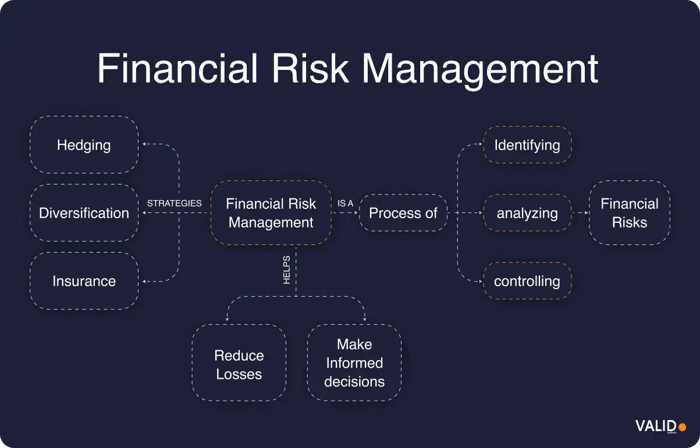
It focuses on anticipating uncertainties that may impact profits, investments, or overall financial performance, and on implementing structured strategies to reduce, transfer, or control those risks effectively.
Types of financial risks to manage
Financial institutions are exposed to a range of financial risks, each requiring a tailored approach to identify, manage, and mitigate them. Here are five types of financial risks you should pay attention to:
1. Market risks
Market risk in banks is the risk of financial losses arising from adverse movements in market prices, such as interest rates, foreign exchange rates, equity prices, and commodity prices, affecting both on- and off-balance-sheet positions.
It primarily affects a bank’s trading activities and capital, requiring robust risk management practices, including stress testing and prudent capital allocation.
2. Credit risks
Credit risk occurs when a borrower fails to repay a loan or meet contractual obligations.
Financial institutions can reduce this risk by:
- Conducting credit checks on customers before extending credit
- Offering shorter payment terms to reduce exposure to late payments
- Diversifying revenue sources to avoid over-reliance
- Implementing automated accounts receivable and accounts payable systems to ensure timely payments and stable cash flow
3. Liquidity risk
Liquidity risk is the risk that a bank may not have enough cash to meet its short-term obligations, such as customer withdrawals or payment demands.
Banks reduce this risk by closely monitoring cash flows, holding enough liquid assets, and having access to emergency funding or credit lines.
4. Operational risk
Operational risk arises from failures in internal processes, systems, or equipment. It also includes human error, which can result in direct or indirect losses.
Financial institutions can mitigate this risk by strengthening internal controls, improving staff training, and using integrated systems such as enterprise resource planning (ERP) software to monitor operations and identify inefficiencies.
5. Legal and regulatory risk
Legal and regulatory risk results from a bank’s failure to comply with laws, regulations, or reporting requirements, which can lead to financial penalties, legal action, and reputational damage.
This risk can be managed by closely monitoring regulatory changes, ensuring accurate tax reporting, and relying on internal controls and external experts (auditors, consultants, and legal counsel) to maintain compliance.
Financial risk management process
Financial risk management operates through a continuous cycle of identifying risks, assessing their impact, implementing controls, and monitoring outcomes to manage financial exposure effectively. Here is how the process works:
1. Risk identification
Identifying risks begins with a careful review of an organization’s operations, financial transactions, and market conditions that could impact its financial health.
Modern tools, such as integrated ERP and accounting systems, make this process easier by tracking financial data in real time and revealing both obvious and hidden risks early.
2. Risk analysis
Once risks have been identified, the next step is to evaluate them more closely to understand why they might occur and how much damage they could cause.
Financial institutions often use a mix of judgment and simple calculations, such as estimating expected loss by multiplying the chance of a risk occurring by its potential financial impact.
For example, if there is a 15% chance of a $40,000 loss, the expected loss would be $6,000, making it easier to decide whether the risk is acceptable before moving forward.
3. Risk prioritization
After analyzing potential risks, financial institutions must decide which ones require immediate attention. Risks that are both more likely to occur and more damaging to financial health are usually prioritized over those with smaller or less probable consequences.
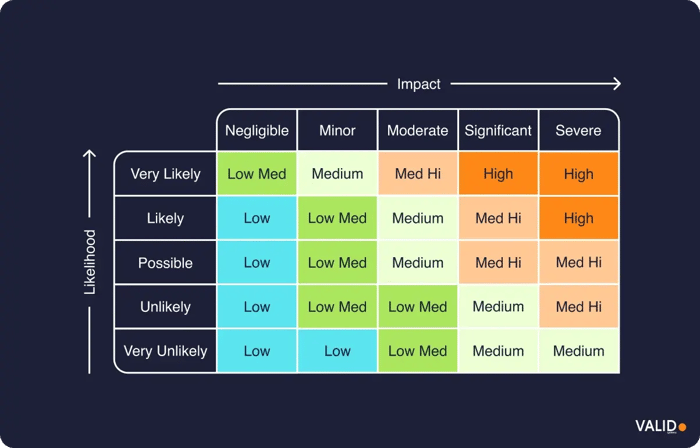
By ranking risks this way, organizations can focus their time and resources on the most serious threats before addressing less urgent concerns.
4. Risk mitigation
This stage focuses on applying practical solutions that limit potential damage, shift responsibility, or prevent the risk from occurring in the first place.
The response will vary depending on how serious the risk is, how likely it is to occur, and what the business is realistically able to do.
Examples of mitigation actions may include:
- Adjusting organizational activities to reduce exposure
- Shifting potential losses to a third party
- Using financial safeguards to balance uncertainty
- Tightening processes and oversight to prevent errors
5. Risk monitoring and reporting
Risk management does not end once controls are in place, as risks and conditions continue to evolve.
Regular monitoring helps banks determine whether their responses are effective and identify when adjustments are needed. Ongoing reporting also keeps key stakeholders informed by highlighting changes in risk levels, underlying causes, and overall progress.
6. Plan review and revision
At regular intervals, organizations should step back and evaluate how well their risk management efforts are performing. This review should highlight successful actions, expose gaps, and bring attention to new or changing risks that may require a different approach.
Best techniques for effective financial risk management
There are several widely used financial risk management techniques, each offering unique insights.
1. Hedging
Hedging is a strategy that reduces potential losses and protects against unfavorable or unexpected changes in key financial factors. These risks often include fluctuations in currency exchange rates, interest rates, and commodity prices.
Hedging can involve financial instruments, but it also includes structural balance-sheet and funding decisions, such as:
- Using derivatives (forwards, futures, options, and swaps) to manage market exposure
- Locking in fixed-rate funding to reduce sensitivity to interest-rate changes
- Choosing diversified or flexible funding sources to manage liquidity risk
- Entering into forward contracts to stabilize variable cash flows
2. Diversification
Diversification refers to how a bank structures its business, revenue streams, and customer base to reduce concentration risk.
A bank that depends heavily on a single product, market, or customer segment is more exposed to unexpected changes, such as economic downturns, regulatory shifts, or changes in customer demand.
Diversification helps reduce this risk by:
- Expanding product offerings (e.g., lending, payments, wealth, or treasury services)
- Serving different customer segments across industries or geographies
- Entering new markets or regions to reduce local economic exposure
- Balancing interest and non-interest income sources
3. Corporate governance
Strong corporate governance helps banks manage risk by setting clear rules for decision-making and organizational operations. It ensures accountability, ethical behavior, and compliance across all levels of the bank.
Effective corporate governance includes:
- Clear policies and standards that guide decision-making and daily operations
- Strong internal controls to reduce errors, fraud, and misuse of funds
- Compliance with regulatory, legal, and labor requirements
- A culture that promotes risk awareness and ethical conduct
4. Tracking risk metrics
Banks use quantitative measures to identify, monitor, and manage risk. These measures include statistical models, key performance indicators (KPIs), and other financial metrics that help decision-makers understand exposures and take action.
Effective risk measurement starts with choosing the right metrics for the risk being managed. Here are some metrics to consider:
|
Risk area |
Key metric |
What it measures |
Why it matters |
|
Profitability |
Return on Assets (ROA) |
Net income relative to total assets |
Shows how efficiently the bank uses its assets to generate earnings |
|
Net Interest Margin (NIM) |
Interest income minus interest expense |
Indicates core lending and funding profitability |
|
|
Liquidity |
Liquidity Coverage Ratio (LCR) |
High-quality liquid assets vs. short-term outflows |
Assesses ability to withstand short-term liquidity stress |
|
Operating Cash Flow Ratio |
Operating cash flow ÷ current liabilities |
Measures the ability to meet short-term obligations from core operations |
|
|
Capital & Leverage |
Capital Adequacy Ratio (CAR) |
Regulatory capital relative to risk-weighted assets |
Ensures the bank can absorb losses and meet regulatory requirements |
|
Leverage Ratio |
Tier 1 capital ÷ total exposure |
Limits excessive balance-sheet leverage |
|
|
Credit Risk |
Non-Performing Loan (NPL) Ratio |
Non-performing loans ÷ total loans |
Indicates asset quality and credit risk exposure |
|
Loan Loss Coverage Ratio |
Loan loss reserves ÷ non-performing loans |
Measures the ability to absorb credit losses |
|
|
Market Risk |
Interest Rate Sensitivity (GAP / Duration) |
Asset–liability repricing or duration mismatch |
Assesses exposure to interest-rate movements |
|
Funding Stability |
Net Stable Funding Ratio (NSFR) |
Available stable funding vs. required stable funding |
Measures longer-term funding resilience |
Benefits and challenges of financial risk management
Financial risk management offers significant advantages for organizations, but it also presents practical challenges that must be carefully addressed to ensure long-term stability and informed decision-making.
Benefits:
- Encourages cross-department collaboration: Risk management brings together insights from finance, operations, marketing, and other teams to ensure risks are evaluated from multiple perspectives and addressed more effectively.
- Enhances operational efficiency: Identifying financial risks helps organizations uncover inefficiencies, eliminate redundancies, and reduce bottlenecks in their processes. This often leads to the adoption of automation and other productivity-enhancing solutions that lower costs and minimize waste.
- Reduces the likelihood and impact of financial risk: Proactive risk management allows organizations to anticipate potential financial disruptions before they affect cash flow or customer demand. By planning ahead, businesses can take preventive actions that protect liquidity and maintain operational stability.
- Builds confidence in financial reporting: Managing financial risk requires clear, accurate, and timely financial information that reflects an organization’s true financial position. Reliable reporting strengthens decision-making and increases confidence among stakeholders, lenders, and investors.
- Enables effective risk mitigation strategies: A structured financial risk management framework helps organizations identify, evaluate, and prioritize appropriate risk-treatment options. This creates a clear roadmap for strategic investments and operational improvements that reduce exposure to financial uncertainty.
Challenges:
- Maintaining accurate and reliable data: Effective financial risk management depends on high-quality financial data from across the organization. Inaccurate, incomplete, or outdated data can weaken risk assessments and lead to poor decision-making.
- Balancing risk management with costs: Developing robust financial risk controls often requires significant investment in systems, expertise, and ongoing monitoring. Organizations may struggle to justify these costs, especially when immediate benefits are not easily measurable.
- Adapting to regulatory and market changes: Financial regulations and market conditions frequently evolve, introducing new risks and compliance requirements. Keeping risk management practices up to date can be complex and resource-intensive.
- Embedding risk awareness across the organization: Financial risk management is most effective when it is understood and supported at all levels of the business. A lack of risk awareness or resistance to change can limit the effectiveness of policies and controls.
Meet VALID: The future of financial risk management
As financial risks grow more complex, organizations must move beyond outdated systems and after-the-fact responses. Modern risk management depends on real-time insights, intelligent automation, and stronger collaboration across the industry.
This sits at the core of what VALID Systems delivers.

VALID Systems is a financial technology company specializing in fraud prevention and risk management solutions for banks, financial institutions, and credit unions.
Leveraging advanced machine learning, behavioral analytics, and industry data collaboration, VALID enables organizations to reduce fraud losses, strengthen compliance, improve operational efficiency, and enhance the customer experience.
Why you should try VALID:
- Real-time fraud detection – Instantly detect and block check fraud across mobile, ATM, and in-branch deposits, enabling proactive loss prevention while minimizing operational disruption.
- Reduced losses and false positives – VALID’s CheckDetect technology captures up to 95% of fraud losses while reducing false positives by up to 40%, allowing teams to focus on the alerts that matter most.
- Comprehensive, multi-channel fraud coverage – From check fraud and account takeovers to loan application fraud, VALID’s solutions address multiple threat vectors through a unified risk management approach.
- Operational efficiency through automation – Decisioning driven by machine learning streamlines fraud reviews, shortens investigation cycles, and reduces manual workload, freeing teams to focus on higher-value analysis.
- Smarter, data-driven risk decisions – Through the Edge Data Consortium, institutions gain access to shared, anonymized industry fraud data, helping them identify emerging threats earlier and improve forecasting accuracy.
- Guaranteed risk protection – VALID’s Guaranteed Loss Coverage model absorbs the cost of covered deposit losses, providing financial institutions with added confidence and stability.
Contact us today and discover how VALID’s real-time, data-driven financial risk management solutions can help you reduce fraud losses, strengthen compliance, and protect your institution’s financial future with confidence.