

Check fraud remains a major threat to financial institutions today. According to the Federal Reserve Survey, 62% of financial institutions experienced check fraud attempts in 2024, up 10% from the previous year. The schemes themselves are becoming more sophisticated, which makes detection and damage mitigation increasingly difficult.
The consequences extend well beyond immediate financial losses. Fraud strains operations, damages institutional reputation, and undermines your clients' trust.
This guide explains how to spot a fake check, protect your institution from loss, and file the required reports.
Key takeaways
- Fake checks reveal themselves through various clues
Look for thin paper, smooth edges, missing watermarks, smudged microprinting, and inconsistencies in MICR lines. Variations in ink color, handwriting, or spacing often indicate alteration.
- Physical inspection alone is no longer enough
Technology such as high-resolution printing and AI-generated signatures makes fake checks harder to spot visually. More advanced solutions, such as behavioral analytics, are now essential for spotting fake checks.
- Fraud prevention requires coordination across your institution
Effective check fraud defense combines client education, frontline staff training, AI-powered detection, and strong internal controls.
- Reporting obligations are time-sensitive and non-negotiable
The report must be filed within 30 days of detecting suspicious activity, or 60 days if no suspect is identified. Also, missing the UCC midnight deadline for returning dishonored checks can result in strict liability for the full amount.
- Real-time decisioning stops fraud before it becomes a loss
Rather than reacting after funds are released, VALID evaluates check risk at the moment of deposit using machine learning, behavioral analytics, and consortium intelligence. This approach captures up to 95% of fraud losses while keeping false positives low and operations efficient.
What is a fake check scam?
A fake check scam occurs when an individual or group illegally manipulates checks to obtain money or goods. Tactics may involve altering legitimate checks, creating counterfeits, or using stolen checks or bank information to deposit the victim's funds.
Fake checks often appear convincing, as fraudsters today use advanced technology such as high-resolution printing and AI-generated signatures. Fraudulent checks may resemble business or personal checks, cashier's checks, money orders, or electronically delivered payments.
Many fake check scams follow this pattern:
- The fraudster offers to send money to the victim
- They write a fake check for more than the amount owed
- They instruct the recipient to wire the excess funds back
- The victim complies and then realizes that the check is fraudulent
These schemes typically target consumers through fake job offers, online sales, sweepstakes winnings, or deals involving money safekeeping.
Types of check scams
Check fraud takes many forms, but certain schemes appear more frequently than others. Understanding these common tactics helps fraud teams recognize threats faster and respond more effectively:
| Type of check scam | How it works | Signs to look out for |
| Counterfeit checks | Fraudsters create fake checks that mimic legitimate ones, often using stolen account details. |
|
| Check washing | Criminals steal legitimate checks and use chemicals to erase the original ink, and then rewrite the payee name or amount. |
|
| Forged signature | Fraudsters sign stolen checks with a forged signature and present them for deposit or withdrawal using fake documents. |
|
| Check kiting | Fraudsters exploit delays in check processing by writing checks between accounts and withdrawing funds before the checks clear. |
|
| Duplicate deposits | Fraudsters deposit the same check into multiple accounts, often across different channels, such as mobile or in-person. |
|
| Account takeover | Criminals gain unauthorized access to a client's account and issue checks without their knowledge. | Inconsistent transactions or withdrawals |
Why are check scams still common in 2026?
While overall usage is declining, around 90% of organizations still use checks, according to J.P. Morgan's 2025 report. For fraudsters, that means fewer opportunities but potentially bigger payoffs.
Several factors make checks a popular target. Many financial institutions still rely on legacy systems and manual verification processes that struggle to keep pace with modern fraud tactics.
At the same time, new technology designed to make banking more convenient has opened new doors for exploitation. Remote deposit capture (RDC) and digital onboarding systems are frequent targets for duplicate deposits and counterfeit checks.
The mail system also remains a weak point today. In its H1 2024 report, the Financial Crimes Enforcement Network (FinCEN) states that it received over 15,417 reports of mail theft-related fraud across 841 institutions.
Economic pressures have contributed to the problem. Pandemic-era relief payments reinforced checks as a legitimate financial instrument, and ongoing inflation has sustained the financial stress that can push individuals toward fraud.
Criminals also have more resources at their disposal. Social media and dark web marketplaces provide easy access to personal data and stolen checks. Additionally, generative AI has made counterfeiting more widespread and refined.
How to spot fake checks
Detecting a fraudulent check requires attention to both physical details and contextual red flags.
Signs of fake checks
A counterfeit check may appear legitimate at first glance, but close inspection of the following elements can reveal whether it really is:
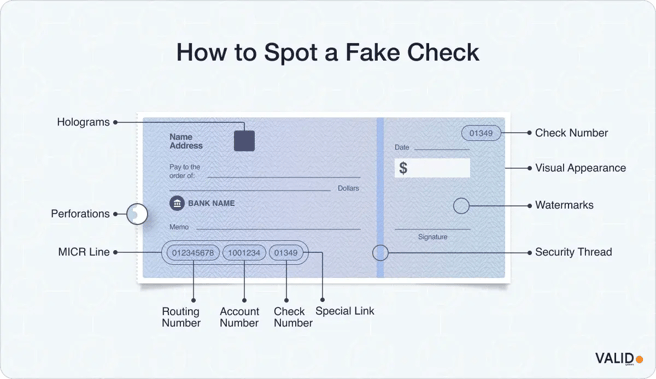
- Material and weight: Authentic checks are printed on high-quality, secure paper with a distinct texture and weight. If the paper feels thin, flimsy, or similar to standard printer stock, treat it with suspicion.
- Check shape: Legitimate checks, particularly cashier's checks and business checks, feature perforated edges where they were separated from a checkbook. Smooth edges on all sides may indicate a counterfeit printed on plain paper.
- Special indicators: Hold the check up to the light and look for watermarks and holograms. These are difficult to replicate, so fraudulent checks usually lack them. Official checks also have microprinted text, which is often missing or appears smudged on fake checks.
- MICR line: Inspect the MICR line at the bottom of the check carefully. Genuine MICR ink is magnetic, has a distinctive feel, and doesn't smear when lightly rubbed with a damp finger.
- Numbers: The routing number on the MICR line should correspond to the bank name printed on the document. Also, compare the check number with the number printed in the top right corner. Mismatches indicate tampering or counterfeiting.
Signs of altered checks
Altered checks often reveal themselves through subtle inconsistencies.
Watch for variations in handwriting style between different fields. If the payee name appears to be written in a different style than the amount, someone may have modified the check after it was issued. The same logic applies to ink color. Different shades or pen types across the check warrant closer examination.
Smudging, faded areas, or faint traces of previous text suggest chemical washing or erasure. Other signs include misaligned or cramped text and unusual character spacing.
It's important to always verify if the written amount matches the numerical amount. Discrepancies between these two fields are among the most common indicators of check alteration.
How to avoid fake check scams
Preventing check fraud requires a coordinated effort across your institution. Technology plays a critical role, but so do informed clients, well-trained staff, and sound internal controls.
Educate your clients
Clients are often the first point of contact with a fraudulent check. When they understand how scams work, they're far less likely to fall victim and may even help others avoid them.
Offer educational resources that address common types of scams. Encourage clients to question and quickly report any check that arrives unexpectedly or comes with odd instructions.
You can also help clients prevent and detect scams by offering self-service controls on spending limits and identity verification. Make sure they also receive real-time alerts and notifications for potentially fraudulent activities, such as transfers and account changes.
Train your employees
Invest in training for your tellers and customer service representatives. They should be able to recognize both physical and behavioral signs of fake check scams during transactions.
Certain scenarios should raise immediate concerns:
- A new or inactive account is depositing large checks from unrelated third parties.
- The same check is deposited multiple times through different channels.
- An individual is insisting on cashing a check immediately.
- A client is uncertain about the check's origin and is being pressured to return a portion of the funds, often via wire transfer, mobile payment, or gift cards.
- The deposit is made in an area far from the client's typical location.
In case they suspect fraud, employees should pause the transaction, investigate the situation, and, if needed, escalate the issue. Simulations can help your staff gain experience, and knowing the signs and proper ways to address the situation will help your team minimize losses.
Implement and enforce control measures
Aside from training your staff, you should also establish strict internal controls, such as:
- Dual authorization: Make sure at least two employees review and approve each high-value check deposit. That way, you can't have a single point of failure with significant losses.
- Access restrictions: Define a clear hierarchy for access to sensitive data. Restricting access based on job function limits exposure and reduces the risk of errors or misuse.
- Holding period: Placing a hold gives you time to verify the legitimacy of suspicious checks before funds become available. This measure is key for new accounts and atypical activity.
- Regular audits: Reassess your controls and security measures regularly. Fraud tactics evolve, so it's important to identify and address new threats before fraudsters can exploit them.
Take advantage of AI
Today, many financial institutions rely on AI and machine learning, as these technologies allow precise, real-time detection at scale. Key capabilities include:
- Image forensic analysis: AI can analyze check images at the point of deposit and identify alterations, signature inconsistencies, and anomalies in handwriting or layout.
- Behavioral analytics: AI can assess whether a transaction fits the account's typical patterns and flag deviations.
- Real-time risk scoring: AI can evaluate checks against multiple data points and estimate risk levels.
- Automated alerts: Fraud teams receive a notification immediately in case of a high-risk event.
- Internal role monitoring: AI can help track user access and identify unauthorized activity.
- Dark web monitoring: AI can search the dark web and other platforms and recognize if an account holder's checks or information are available for sale.
Collaborate with other institutions
Consortium databases allow financial institutions to share data on suspicious accounts, devices, and tactics. For example, if one institution flags a check as fraudulent, other institutions can identify it immediately if they encounter it.
By collaborating with regulators, industry groups, and peer institutions, you can help strengthen network-wide detection and prevent threats before they reach clients.
How to report a fake check
When you identify a fraudulent check, swift action is needed to ensure compliance and limit losses. It's also important to document every step of your investigation; the reporting process depends on the type of fraud, the amount involved, and the stage of the transaction.
Filing a report
You are required to submit a Suspicious Activity Report (SAR) to FinCEN's online portal within 30 days of detecting suspicious activity. If you can't identify a suspect at the time of detection, you can extend the deadline to 60 days, but no more than that. These rules apply to checks as well as any other transaction involving fraud or crime.
Reporting is necessary in case of:
- Insider abuse involving any amount
- Violations of $5,000 and more when the suspect is known
- Violations of $25,000 and more, regardless of whether the suspect is identified
- Any activity that suggests a broader pattern of fraud
For situations requiring immediate attention, such as ongoing fraud, you must also reach out to your primary regulator and notify an appropriate law enforcement authority by telephone. This is usually the local office of the IRS Criminal Investigation Division or the FBI.
%20Matters.webp?width=656&height=276&name=Why%20Filing%20a%20Suspicions%20Activity%20report%20(SAR)%20Matters.webp)
If the check has already cleared
Under Uniform Commercial Code (UCC) 4-302, the paying bank must return a dishonored check or send notice by midnight of the next banking day after receiving it. Missing this deadline can result in strict liability for the full amount, even if the check is fraudulent.
In general, liability depends on the type of fraud. For altered checks, the bank of first deposit ultimately bears the loss, while the paying bank is responsible for forged signatures and counterfeits.
Recovery through UCC warranty claims is possible, but disputes over classification can complicate the process. For substitute and electronic checks, Regulation CC presumes the item was altered rather than forged, though you can challenge this presumption with sufficient evidence.
How VALID Systems can help you reduce the risk of fake check scams
Fake check scams succeed when fraud is detected too late. By the time a traditional system flags a suspicious item, funds may already have been released, and the fraudster may be long gone. VALID takes a different approach.
VALID is an AI-driven fraud prevention platform that evaluates check risk at the moment of deposit, across mobile, ATM, and in-branch channels. Processing over $4 trillion in annual transaction volume for major US financial institutions, VALID delivers the intelligence needed to stop fraud before it becomes a loss.
Here's how VALID protects you against check fraud:
- CheckDetect delivers real-time scoring at presentment and identifies high-risk deposits before funds are released. Configurable thresholds align with your risk strategy, while severity-based scoring helps fraud teams prioritize reviews.
- Edge, VALID's fraud data consortium, connects your institution to shared intelligence across a network of banks, surfacing scam patterns that no single institution could detect alone.
- Inclearing Loss Alerts applies machine learning during the clearing process to catch fraudulent items that bypass traditional image-based controls.
- InstantFUNDS enables sub-second deposit decisions with guaranteed funds availability, which improves both security and customer experience.
Also, VALID Systems is the only provider that both detects check and ACH fraud at the moment of deposit and guarantees coverage against losses.
Get in touch today and stop fake check scams before they affect your bottom line.