

Many financial institutions are starting to feel the growing challenge of staying ahead of fraud while still delivering a seamless customer experience. For that reason, they are relying on smarter, data-driven tools to quickly pinpoint which transactions or users warrant a closer look.
With the right scoring approach in place, your team can move faster, reduce false positives, and stop suspicious activity before it causes real damage.
In this article, we’ll explore what fraud risk scoring is, how it works, and how it can strengthen your overall fraud-prevention strategy.
Key Takeaways
- Fraud risk scoring helps institutions identify high-risk activity quickly
By analyzing behavioral patterns, device data, digital footprints, and other signals, scoring systems highlight suspicious users or transactions early, giving teams a chance to prevent fraud before losses occur.
- White-box and black-box models each have strengths, but both fall short alone
White-box models offer transparency and control but struggle to detect new fraud patterns. Black-box models are powerful but lack explainability and can create compliance challenges, especially in regulated financial environments.
- Strong fraud programs require governance, explainability, and reliable data
Financial institutions must comply with regulations like SR 11-7, Reg B, FCRA, and CFPB guidance. This requires thorough model validation, clear adverse-action reasoning, robust audit trails, and continuous monitoring to avoid drift and misclassifications.
- The biggest scoring failures come from outdated logic and missing context
Fraudsters exploit systems that are not frequently updated, lack behavioral context, or rely on incomplete data. This leads to false positives, missed attacks, and friction for good customers.
- VALID Systems delivers real-time scoring, shared intelligence, and guaranteed protection
VALID’s behavioral and network-based scoring detects fraud with high accuracy, while the Edge Data Consortium provides industry-wide insights that no single institution can gather on its own.
What is fraud risk scoring?
A fraud score is a numerical measure that reflects how likely a user, account, or transaction is to be fraudulent, based on a combination of risk signals.
Modern fraud-scoring systems use AI and machine learning to analyze data points, such as device details, IP addresses, behavior, and historical patterns, and assign a score that represents overall risk.
Benefits of fraud risk scoring
Adopting this protection approach gives you the power to strengthen security on multiple fronts, helping you:
- Spot risks sooner: Fraud risk scoring helps you catch unusual behaviour the moment it starts, giving you a chance to shut down fraud before it becomes a problem.
- Focus your team where it matters: By highlighting only the highest-risk activity, fraud scoring saves you from endless manual reviews and frees your team to concentrate on cases that truly need attention.
- Keep real users protected: As risky behaviour is filtered out in real time, your genuine customers can use your service without interruptions or unnecessary friction.
- Create a smoother customer experience: When your fraud checks work quietly and accurately in the background, your customers enjoy quicker approvals, fewer frustrations, and a service they can trust.
How does fraud scoring work?
Each time a user does something, whether it’s signing in or making a purchase, it triggers a series of steps designed to assess the risk. Here’s how it works:
- Step 1: A user tries to register, log in, change account details, or make a payment.
- Step 2: The system captures input data (email, phone number, name, address, etc.) and technical signals (device type, browser, IP address, and location).
- Step 3: Additional context is added using digital footprint checks, device intelligence, reputation databases, and external sources to uncover patterns, history, and known risk markers.
- Step 4: All signals are fed into the scoring engine, where rules and models assign weighted positive or negative values to each attribute based on risk.
- Step 5: The system calculates a final fraud score. With white-box machine learning, the logic and contributing factors remain transparent and explainable.
- Step 6: Based on predefined thresholds, the action is automatically approved, declined, or routed to manual review for further investigation.
For example, a customer submits a card-not-present payment through your banking platform. As the request enters the fraud engine, the system quickly checks several independent risk indicators.
During this check, the customer’s email fails basic credibility tests, their identity information appears thin, and their behavior doesn’t match what the bank normally sees from trusted users.
On top of that, the login originates from a hosting provider IP address and uses a newly created free email address, both patterns frequently associated with automated or disguised activity.
Fraud score ranges and calculations
To understand how these signals translate into overall risk, the table below shows a typical breakdown of fraud-score ranges.
|
Score Range |
Risk Level |
Typical Action |
|
0–30 |
Low Risk |
Auto-approve |
|
31–60 |
Medium Risk |
Step-up verification or light review |
|
61–100 |
High Risk |
Manual review or auto-decline |
When these signals are combined, the transaction receives a fraud score of 80/100, placing it well above the bank’s high-risk threshold. Based on internal rules, this would either stop the payment immediately or send it to an analyst before any funds move.
To better understand how different signals contribute to the overall score, the table below summarizes the critical factors that influence fraud score calculations.
|
Factor |
How the system uses this factor |
|
Behavioural anomalies |
Captures unexpected or inconsistent user actions that deviate from normal behaviour patterns. It helps you identify situations where a user’s activity does not align with what is typically considered genuine or trustworthy. |
|
Transaction irregularities |
Highlights unusual characteristics within a transaction, including surprising amounts, abnormal frequency, or unexpected locations. It provides early warnings when the activity may not match the profile of legitimate use. |
|
IP and geolocation risk |
Reflects indicators tied to the source of network activity, such as suspicious IP ranges, mismatched locations, or access from high-risk regions. It helps you assess whether the connection environment is consistent with trustworthy behaviour. |
|
Email reputation |
Evaluates the overall trustworthiness of the email address being used, taking into account domain quality, age, and known history. It helps you understand how credible and stable the user’s digital identity appears. |
|
Network relationships |
Examines links between accounts, devices, or transactions that may suggest shared origins or coordinated activity. It helps uncover clusters of behaviour that could indicate organised or connected fraud patterns. |
|
Device intelligence |
Assesses signals gathered from the device involved, including device fingerprint consistency, configuration stability, or signs of virtualization. It helps confirm whether the device aligns with the behaviour of genuine users. |
|
Historical credibility |
Captures long-term indicators of trust based on past interactions, successful transactions, and established identity elements. Strong history reduces risk while thin or inconsistent records increase uncertainty. |
|
Model-derived risk scores |
Uses outputs generated by analytical models that evaluate multiple data points simultaneously. It reflects how closely the current activity aligns with known patterns of safe or risky behaviour. |
Fraud risk scoring challenges and limitations
Fraud scoring is a powerful defense against evolving threats, but it comes with limitations that organizations must understand in order to keep their systems effective.
- Variability in thresholds: Score thresholds differ across tools and industries, so what one platform labels as “high risk” might be seen as low or moderate elsewhere. As a result, fraud scores can vary dramatically between organizations, making standardization difficult.
- Outdated scoring logic: When scoring logic isn’t refreshed frequently, fraudsters can learn how to exploit outdated patterns. Without continuous updates, the system becomes less accurate and loses its ability to detect emerging threats.
- Misclassification risks: Even advanced systems occasionally misclassify transactions, blocking legitimate activity or missing fraudulent attempts. These errors can erode customer trust and increase fraud-related losses.
- Data reliability issues: Fraud scores rely heavily on accurate, timely, and well-integrated data to function properly. Poor data quality or missing external signals can significantly reduce scoring reliability.
- Context gaps in evaluation: Many scoring systems evaluate behavior in isolation, lacking deeper context to clarify whether an activity is legitimate or suspicious. This can lead to oversimplified decisions and reduced detection precision.
Whitebox vs blackbox scoring models
In traditional fraud risk scoring, there are typically two core types of models, each with different strengths and trade-offs:
White-box fraud scoring models
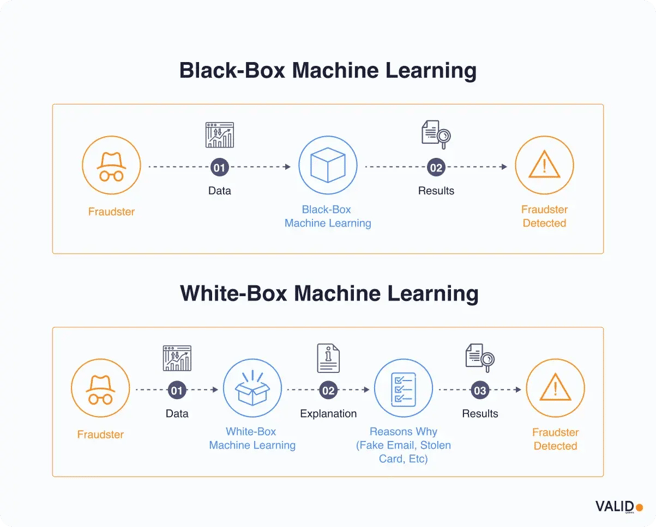
White-box models are fully transparent. They allow businesses to see exactly how every fraud score is generated, step by step. Its key characteristics include:
- Clear decision logic: You can identify which signals, such as device behavior, IP reputation, transaction velocity, or user history, contributed to a decision.
- Easy customization: Because the logic is exposed, teams can adjust thresholds, rules, and scoring criteria to align with evolving business strategies, risk tolerance, or compliance requirements.
- Explainability: When a customer disputes a declined transaction, your team can explain the decision. This is also beneficial for internal audits and regulatory reviews that require justification of automated decisions.
- Predictability: White-box models behave consistently. If a rule says “flag any transaction above X,” you know exactly what will happen. This predictability makes them easier to manage, but it sometimes limits their ability to detect subtle or emerging fraud patterns.
Black-box fraud scoring models
Black-box models use advanced machine learning algorithms to predict fraud risk from patterns in the data, often uncovering relationships that are too complex for manual rules. Its key characteristics include:
- High detection capability: By analyzing millions of data points, black-box models can spot hidden correlations or emerging fraud tactics that traditional rules might miss.
- Less manual maintenance: Instead of writing and adjusting dozens of rules, teams rely on the model’s ability to learn from new data.
- Limited transparency: The reasoning behind a high or low fraud score may be difficult or impossible to interpret, making it harder to justify decisions to customers or regulators.
- Ongoing training required: Their accuracy depends on regularly retraining the model with updated data. Without this, performance can degrade as fraud patterns evolve.
- Potential compliance challenges: In industries that require explainability, such as financial services, black-box models may face scrutiny because they can’t easily demonstrate how decisions were made.
The hybrid approach
Both white-box and black-box models struggle to keep pace with modern fraud, as white-box systems require constant manual updates while black-box systems lack transparency when legitimate customers are mistakenly flagged.
Even when combined, these approaches remain reactive rather than proactive, relying on historical patterns that fraudsters quickly evolve past.
Pro tip
Tools like VALID Systems address these limitations through real-time fraud scoring and decisioning, assigning risk scores to each check transaction at the moment it occurs using behavioral, transactional, and payer–payee network insights.
To stay ahead of emerging fraud trends, solutions such as the Edge Data Consortium further strengthen defenses by enabling institutions to securely share intelligence across an AI-powered network.
This allows banks and credit unions to detect patterns earlier and prevent threats like counterfeit checks, account fraud, and loan application scams before they escalate.
Model governance, compliance & regulatory requirements
Banks, credit unions, and fintech companies must ensure that scoring models are explainable, well-governed, and compliant with industry regulations.
Below are the key governance and compliance requirements every financial institution must address.
1. Model validation & risk management
Fraud-scoring models used by financial institutions must follow model risk frameworks such as SR 11-7 and OCC 2011-12, which require strong controls over accuracy, stability, and governance. This includes:
- Independent model validation
- Performance testing (false positives, drift, stability)
- Version control and documented update processes
- Ongoing monitoring through MLOps
2. Explainability requirements
When fraud scoring affects onboarding, payments, or credit decisions, institutions must be able to explain why a decision occurred. Key regulations are:
- ECOA/Reg B: Must give clear reasons for adverse actions
- FCRA: Requires accuracy and dispute handling when external data is used
- CFPB guidance: Requires creditors to provide specific and accurate reasons for adverse actions, even when using complex AI or black-box models
3. Operational resilience
Fraud scoring systems must stay available and fast, as delays or outages can block payments and logins. Institutions need:
- High availability and fallback logic if models fail
- Low latency scoring (typically <300 ms)
- Stress testing and controlled change management
If scoring goes down, payments, logins, or onboarding can fail, creating both fraud exposure and regulatory issues.
4. Recordkeeping & audit trails
Banks and fintechs must log each fraud decision, including the score, data inputs, and model version used.
These records help with regulatory audits, customer disputes, and investigations. Most institutions retain this data for 5–7 years to meet compliance standards.
How to choose the best fraud risk scoring system
When selecting a fraud risk scoring system, focus on tools that are accurate, adaptable, and easy to integrate into your existing processes. Here’s what to look for:
- AI and machine learning intelligence: Choose a solution powered by AI/ML that can detect patterns, learn from new fraud tactics, and continually improve its accuracy. This ensures your protection becomes stronger over time.
- Real-time, dynamic scoring: A great system should provide instant risk assessments and automatically adjust scores as new information comes in. This enables quick decision-making and reduces the need for manual reviews.
- Comprehensive data coverage: For a more complete and reliable risk profile, look for platforms that analyze a wide range of data, such as behavioral signals, transaction history, device information, and more.
- Customization and flexibility: Your business is unique, and your fraud tool should reflect that. The system should allow you to tailor risk thresholds, rules, and models without heavy developer involvement.
- Scalability for growth: Ensure the technology can support both your current operations and future expansion, handling larger transaction volumes and increasingly complex fraud scenarios.
With these criteria in mind, the line between a standard fraud tool and a truly future-ready solution becomes unmistakable. This is precisely where VALID Systems stands out, offering the intelligence, speed, and protection that modern institutions can’t afford to go without.
Why should you try VALID?
VALID Systems brings a modern, real-time approach to fraud prevention, enabling financial institutions to detect emerging threats with speed, precision, and transparency.
Unlike traditional tools that rely on static rules or single-source data, VALID combines behavioral analytics, transaction intelligence, and payer–payee network insights to score risk the moment a check or transaction occurs.
Backed by guaranteed loss protection and an AI-powered consortium, VALID helps banks move faster, reduce friction, and stay ahead of today’s most sophisticated fraud tactics.
With VALID, you get:
- Real-time, machine-learning decisioning across all deposit channels with 95% fraud capture.
- Guaranteed risk protection where VALID absorbs the loss if a deposit item isn’t alerted and causes a loss, shielding the institution from exposure.
- Edge Data Consortium that provides shared, AI-powered intelligence across institutions to uncover fraud patterns that no single bank can identify alone.
- Financial Health Score that uses behavior-driven analytics to measure customers’ true financial wellness in real time, helping you tailor products, reduce risk, and clearly demonstrate customer value.
- Behavioral, transactional, and network-level scoring that delivers precise, low-false-positive fraud detection without adding friction for good customers.
Contact us today, and secure your institution with VALID’s real-time scoring and guaranteed loss protection.