

Are you looking for a reliable fraud prevention platform that fits your organization’s needs?
While Advanced Fraud Solutions is a popular choice, there are other tools on the market that can offer different features, integration capabilities, and levels of flexibility.
From AI-driven fraud detection to real-time transaction monitoring and compliance support, these tools can help you stay ahead of evolving fraud risks and reduce financial losses.
In this article, we will cover the eight best Advanced Fraud Solutions alternatives to help you find a solution that aligns with your security, compliance, and operational needs.
8 Best Advanced Fraud Solutions alternatives to consider in 2026
Before exploring our top picks in detail, here is a quick overview of what awaits you:
|
Platform |
Best for |
Strengths |
Differentiator |
|
VALID Systems |
Banks and credit unions with a strong check and deposit focus |
Real-time AI check fraud detection, consortium intelligence, and instant deposit decisions |
Only check fraud platform offering loss guarantees with sub-second deposit approvals |
|
Sift |
Banks, fintechs, and digital businesses |
Real-time risk scoring, behavioral analysis, and chargeback automation |
Large global data network delivering scalable, real-time fraud decisioning |
|
Sardine |
Fintechs and banks needing fraud + AML automation |
Behavioral biometrics, true identity piercing, and no-code rule testing |
Deep device and behavioral intelligence with AI-powered compliance operations |
|
SEON |
Fintechs, payment providers, and iGaming companies |
900+ fraud signals, explainable ML, and unified fraud & AML workflows |
Transparent, fully auditable fraud scoring with rapid no-code deployment |
|
Feedzai |
Large banks and global payment providers |
Omnichannel fraud detection, behavioral biometrics, and scam prevention |
Enterprise-grade, real-time fraud and AML coverage at a global scale |
|
DataVisor |
Enterprises fighting complex and organized fraud |
Unsupervised ML, graph-based investigations, and unified fraud & AML |
Patented machine learning that detects new fraud patterns without labeled data |
|
LexisNexis Risk Solutions |
Institutions needing broad identity and risk intelligence |
Multi-dimensional identity data, predictive risk scoring, and behavioral biometrics |
One of the largest global risk and identity data ecosystems |
|
NICE Actimize |
Large financial institutions in heavily regulated environments |
Entity-based risk profiling, consortium intelligence, and automated investigations |
Deep, regulator-tested fraud and financial crime compliance platform |
1. VALID Systems

VALID is an AI-driven risk management and fraud prevention platform that helps financial institutions detect and prevent fraud in real time across digital and check-based transactions.
It uses machine learning and large-scale data intelligence to support smarter fund decisions and more efficient operations.
Processing over $4 trillion in annual check volume across major US financial institutions, VALID provides the insight and intelligence needed to proactively address rapidly evolving fraud threats.
Key features:
- 1. CheckDetect provides real-time check fraud detection across every deposit channel, including mobile, ATM, and in-branch. By capturing up to 95% of fraud losses with minimal false positives, it enables smarter decisions and better fraud outcomes.
With CheckDetect, you get:
- Real-time fraud evaluation the moment a check is deposited
- Configurable risk thresholds aligned to each institution’s risk strategy
- Consistent decision-making across all check deposit channels
- Severity-based scoring to streamline fraud review prioritization
- Immediate communication of holds to reduce customer friction
- Edge enables financial institutions to access shared fraud intelligence across a network of banks. By aggregating transactional data and applying AI, it uncovers fraud patterns that are often not visible to a single institution.
Key capabilities include:
- Analyzing behavioral patterns across multiple institutions to identify hidden fraud risks
- Detecting fraud across key activities, including account opening, funding, lending, and account access
- Enhancing fraud prevention while supporting GLBA compliance
- INclearing Loss Alerts uses machine learning to detect fraud during the check clearing process, identifying fraudulent items that may bypass traditional image-based controls.
It applies AI and behavioral analytics to improve detection accuracy while preserving legitimate transactions.
Key capabilities include:
- Identifying subtle fraud patterns that traditional image-based systems often miss
- Reducing false positives and the need for manual reviews
- Improving fraud loss detection while allowing legitimate transactions to flow smoothly
- InstantFUNDS delivers sub-second deposit decisions that give customers immediate access to their funds, without increasing fraud risk.
By accelerating approval for up to 99% of deposits and guaranteeing covered losses, InstantFUNDS boosts customer satisfaction while unlocking new revenue opportunities for financial institutions.
Pros and cons:
Pros:
- Real-time, AI-powered fraud protection that stops check fraud at deposit and clearing, capturing up to 95% of losses with low false positives
- Shared network intelligence that uncovers fraud patterns that no single bank can detect on its own
- Near-instant deposit decisions and faster access to funds, with built-in loss protection for banks
Cons:
- Primarily focused on deposit fraud, so banks may use it alongside other tools for broader payment coverage
- Best suited for traditional financial institutions, with select fintechs benefiting when deposits are a core use case
2. Sift

Sift is a fraud prevention platform that helps banks, financial institutions, and digital businesses detect and stop fraud, reduce chargebacks, and protect customer trust through real-time, AI-driven risk decisioning.
Powered by a large global data network, it delivers accurate, scalable fraud protection across all stages of user activity and transactions.
Key features:
- Real-time risk scoring – Delivers instant fraud risk assessments through APIs, enabling automated decisions and custom risk workflows
- Dispute and chargeback automation – Streamlines dispute handling with machine-learning–driven recommendations to improve win rates and reduce operational effort
- Behavioral and identity analysis – Detects fraud by analyzing user behavior, devices, and identity signals to identify suspicious activity with higher accuracy
- Fraud intelligence insights – Provides visibility into emerging fraud patterns and trends to help teams proactively adapt their prevention strategies
Pros and cons:
Pros:
- Accurate real-time fraud detection and risk scoring
- Intuitive dashboard with strong investigation tools
- Flexible rules and automation for scaling fraud operations
Cons:
- Complex setup and onboarding process
- Limited transparency in risk scoring decisions
- Inconsistent reporting and data export
3. Sardine
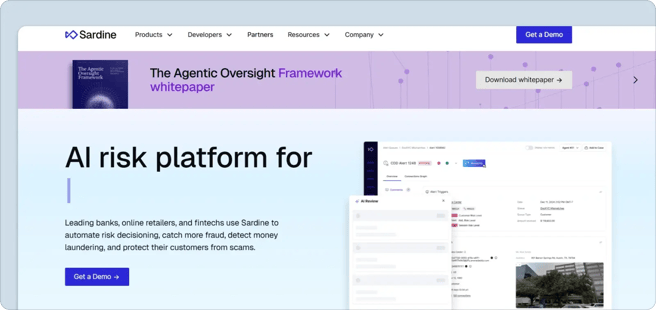
Sardine is an AI-powered risk and compliance platform that helps banks, fintechs, and online businesses prevent fraud, detect money laundering, and protect customers from scams across the entire customer journey.
Using proprietary device intelligence, behavioral biometrics, and modular risk tools, Sardine automates decisioning, reduces fraud losses, and streamlines AML and compliance operations.
Key features:
- Behavioral biometrics intelligence – Analyzes mouse movements, typing patterns, and session behavior to distinguish real users from fraudsters
- True identity piercing – De-obfuscates VPNs, emulators, and remote access tools to reveal a fraudster’s true device, location, and risk profile
- No-code rule testing and deployment – Enables fraud teams to build, backtest, and safely deploy complex risk rules against historical data without engineering support
- AI-powered operations agents – Automates high-effort workflows like KYC resolution, sanctions screening, merchant reviews, and disputes to scale fraud and compliance teams efficiently
Pros and cons:
Pros:
- Powerful behavioral biometrics and flexible fraud rules
- Easy API/SDK integration with strong scalability
- Highly responsive and collaborative customer support
Cons:
- Steep learning curve for new or non-technical users
- Dense interface that can feel complex and signal-heavy
- Limited proactive AI insights and some integration gaps
4. SEON

SEON is a fraud prevention and AML compliance platform that unifies 900+ first-party data signals to help banks, fintechs, payment providers, and iGaming companies detect risk, understand context, and take action from a single command center.
It enables rapid deployment, transparent decisioning, and scalable fraud and compliance coverage without adding friction or slowing growth.
Key features:
- Digital footprint analysis – Analyzes behavioral, network, and online presence signals to identify fraudulent users early in the customer journey
- Device intelligence – Identifies and correlates devices across sessions to detect anomalies and account misuse without relying on cookies
- Custom rules & explainable ML – Allows teams to create granular, no-code rules and combine them with transparent machine-learning risk scores they can fully audit
- Unified fraud & AML workflows – Centralizes fraud detection, sanctions screening, transaction monitoring, and case management in a single investigation environment
Pros and cons:
Pros:
- Explainable fraud scores with clear decision reasoning
- Flexible rule creation without heavy developer reliance
- Fast implementation with responsive customer support
Cons:
- Complex rule management at scale
- Occasional data gaps or null results
- Steeper learning curve for advanced configurations
5. Feedzai

Feedzai is an AI-powered financial crime prevention platform that helps banks and payment providers detect and stop fraud, scams, money laundering, and account abuse in real time. Its end-to-end solution uses behavioral analytics and machine learning to secure digital identity, prevent fraud across channels, and reduce AML compliance costs at a global scale.
Key features:
- Omnichannel risk orchestration – Unifies fraud detection across all payment types and customer channels in real time, enabling consistent decisions from a single risk layer
- RiskOps case management – Centralizes investigation, decisioning, and workflow automation in one platform to improve analyst efficiency and reduce operational complexity
- Behavioral biometrics & scam detection – Analyzes user behavior and interaction patterns to identify scams, social engineering, and account abuse beyond traditional transaction signals
- Network intelligence – Leverages privacy-preserving, cross-institution intelligence to strengthen models with shared fraud signals while maintaining data isolation
Pros and cons:
Pros:
- Strong real-time fraud detection accuracy
- Advanced machine learning and behavioral analytics
- Enterprise-grade scalability for global financial institutions
Cons:
- Complex implementation and system integration requirements
- Longer sales and onboarding cycles
- Lower brand recognition than some legacy competitors
6. DataVisor
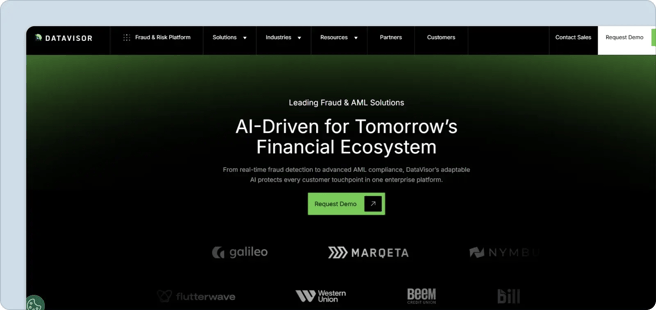
DataVisor is an AI-driven fraud and AML platform that provides real-time detection and risk management across the entire customer lifecycle for banks, fintechs, and payment companies. Built for enterprise scale, it leverages cloud-native architecture and advanced machine learning to deliver fast, accurate decision-making that helps organizations prevent fraud, ensure compliance, and grow securely.
Key features:
- Unified fraud and AML operations – Combines fraud prevention, AML monitoring, KYC/KYB, and case management into a single platform for end-to-end risk coverage
- Graph-based investigation tools – Visualizes relationships between accounts, devices, and behaviors to quickly uncover organized and multi-account fraud activity
- Unsupervised fraud detection – Uses patented machine learning to identify new, previously unseen fraud patterns and coordinated fraud rings without relying on labeled data
- AI-driven automation and rule optimization – Applies AI to recommend, tune, and automate rules and alerts, reducing manual effort while improving detection accuracy
Pros and cons:
Pros:
- Highly customizable rules and scoring logic
- Accurate ML-driven detection of complex fraud
- Scalable platform with strong enterprise support
Cons:
- Complex setup and steep learning curve
- Inconsistent UI usability and stability
- Data-dependent for teams with limited technical capacity
7. LexisNexis Risk Solutions

LexisNexis Risk Solutions is a global data and analytics company that helps organizations manage risk, prevent fraud, and make informed decisions using advanced identity, financial crime, credit risk, and payments intelligence.
Part of RELX, it serves industries such as financial services, insurance, corporations, and gaming by turning large-scale data into actionable insights.
Key features:
- Multi-dimensional identity intelligence – Combines digital, physical, and behavioral identity signals to detect stolen, synthetic, and bot-driven identities in real time
- Predictive fraud risk scoring – Uses advanced analytics and machine learning to generate risk scores and warning indicators that reduce false positives and speed up decision-making
- Behavioral biometrics analysis – Monitors user interaction patterns (such as typing and navigation behavior) to identify anomalous activity without adding friction for legitimate users
- Integrated fraud investigation tools – Provides streamlined investigation workflows and linked intelligence to support faster, more effective manual reviews and case resolution
Pros and cons:
Pros:
- Accurate risk parameter modeling
- Intuitive and easy-to-use interface
- Comprehensive data coverage in one platform
Cons:
- Disruptive reporting workflows
- Broad or imprecise search results
- Overwhelming information volume during investigations
8. NICE Actimize

NICE Actimize is a provider of financial crime, risk, and compliance solutions that help organizations detect, prevent, and investigate fraud, money laundering, and market abuse.
Its technology uses artificial intelligence and machine learning to monitor billions of transactions each day, supporting regulatory compliance and effective risk management.
Key features:
- Real-time fraud detection – Identifies and stops suspicious transactions across channels and payment types as they occur
- Consortium-based intelligence – Leverages shared industry data to improve detection accuracy and adapt to emerging fraud patterns
- Entity-based risk profiling – Connects accounts, devices, transactions, and identities into a single risk view to uncover complex fraud networks
- Automated investigation workflows – Uses AI-driven case prioritization and orchestration to reduce manual effort and speed up analyst decisions
Pros and cons:
Pros:
- Strong fraud detection with reliable alerts and true positives
- Feature-rich platform with deep reporting and data visibility
- Flexible reporting and alert prioritization for investigations
Cons:
- Complex, slow, and unintuitive user interface
- Lengthy, resource-heavy implementation process
- Limited customization, integrations, and timely support
How to choose the best Advanced Fraud Solutions alternative
Today’s leading fraud prevention platforms offer far more than basic fraud detection. They combine real-time decisioning, behavioral intelligence, network insights, and automation to help organizations stay ahead of increasingly sophisticated threats.
If your priority is digital-first fraud prevention with flexible rules, strong identity intelligence, and fast deployment, solutions like Sift, SEON, and Sardine provide scalable, API-driven approaches that work well for fintechs and modern financial teams.
For organizations that need enterprise-grade, multi-channel fraud and AML coverage, platforms such as Feedzai, DataVisor, LexisNexis Risk Solutions, and NICE Actimize deliver advanced analytics, broad use-case support, and powerful investigation tools suited for complex environments.
However, if your goal is to stop fraud before losses occur, especially in check and deposit workflows, VALID stands out as the strongest alternative.
With VALID, you can:
- Stop check fraud the moment a check is deposited, whether it’s through mobile, an ATM, or in a branch
- Catch fraud that traditional image-based systems often miss using AI-driven clearing and behavioral insights
- Use shared intelligence across multiple financial institutions to spot new fraud patterns that a single bank can’t see alone
- Approve deposits in under a second with InstantFUNDS, giving customers faster access to funds while protecting against losses
- Apply clear, consistent, and risk-aligned decisions across all check and deposit workflows
Contact us today to see how VALID delivers smarter fraud decisions, faster fund availability, and stronger protection across every deposit channel.