

Did you know that financial harm due to check fraud accounted for about 30% of all fraud losses in 2024?
Despite advances in digital security, criminals continue to exploit paper checks as one of the easiest entry points for financial fraud.
Fortunately, there are clear guidelines and must-do practices that can significantly reduce your risk of falling victim to these schemes.
We created a check fraud prevention checklist to help you strengthen your controls, reduce losses, and stay ahead of evolving fraud threats.
Key takeaways
- Check fraud is still a major threat, not a legacy problem
Even with digital payments growing, checks remain one of the most targeted payment methods. Criminals exploit the slower processing and weaker controls around checks to commit forgery, counterfeiting, washing, kiting, and remote deposit fraud.
- New accounts are high-risk and require extra scrutiny
Fraudsters frequently use newly opened accounts as “drop” accounts. Strong KYC, enhanced monitoring during the first 6–12 months, and extended holds on early deposits are among the most effective ways to stop losses.
- Positive Pay is one of the highest-impact tools for businesses and banks
Matching presented checks against issued check files can block altered or counterfeit checks before they clear. Payee Positive Pay adds an extra layer by verifying the payee name.
- AI and behavioral analytics are no longer optional for serious fraud prevention
Machine learning that analyzes behavior patterns, deposit channels, and check images in real time helps detect sophisticated schemes like kiting, mule networks, and counterfeit check rings while reducing false positives.
- Cross-bank intelligence and real-time decisioning give you the edge
VALID Systems brings together AI-powered check analysis, real-time deposit decisioning, and cross-bank intelligence through its Edge Data Consortium, helping banks stop fraud earlier, reduce losses, and even unlock new fee revenue safely.
What is check fraud?
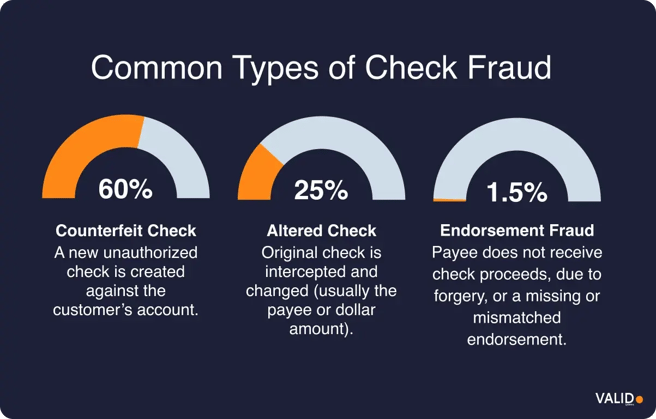
Check fraud is the illegal use of paper or digital checks to steal money, whether through forgery, counterfeiting, altering checks, check kiting, or fraudulent remote deposits.
Despite the rise of electronic payments, about 61% of Americans wrote checks in 2024, which keeps this type of fraud alive.
In fact, paper checks remain the most targeted payment method, with 65% of organizations reporting check fraud incidents; criminals increasingly “revert to older methods” because businesses and consumers have become harder to fool with digital scams.
The many faces of check fraud: Types and tactics
Here are some of the most common types of check fraud:
- Stolen and forged checks: Criminals steal legitimate checks and forge signatures or endorsements to cash or deposit them.
- Counterfeit checks: Fraudsters print fake checks using stolen designs and information from real accounts.
- Check alteration (check “washing”): Thieves chemically erase details on real checks and rewrite the payee or amount.
- Check kiting: Scammers exploit bank processing delays by moving bad checks between accounts to create fake balances.
- Remote deposit capture fraud: Criminals mobile-deposit a check and then also cash or redeposit the physical check.
- Fake check scams: Victims deposit a fraudulent check and send “refunds” or goods before the check bounces.
- Mail theft rings: Organized groups steal checks from mailboxes and alter or counterfeit them for large-scale fraud.
Check fraud prevention checklist: Tools, technologies, and best practices
From strengthening new account monitoring to leveraging AI and industry-wide intelligence, these strategies help stop fraud before losses occur.
1. Strengthen new account screening and monitoring
New accounts, especially business or consumer accounts that quickly start writing or depositing large checks, are often used as vehicles for fraud.
Studies show that 90% of forged checks are drawn on accounts that are less than one year old.
How to prevent it:
- Watch for red flags in new customers: Train staff to identify warning signs of fraudulent accounts, such as activity that doesn’t align with the stated business purpose or suspicious identification. Be especially alert to quick post-opening changes (like adding signers or updating addresses), which may indicate a “drop” account.
- Initial deposit holds: Place extended holds on initial check deposits under Regulation CC to allow time for fraud detection and check verification. This should be clearly communicated as a standard fraud prevention measure, and legitimate customers will typically understand.
- Early account monitoring: Apply stricter monitoring in the first 6–12 months of a new account, and investigate check activity that falls outside expected behavior. For example, sudden large or repeated check deposits shortly after opening should trigger review, as they often indicate elevated fraud risk.
- KYC and verification: Thoroughly verify each customer’s identity and address during account opening, and apply enhanced screening for customers expecting high check volumes. If an ID or address appears questionable, pause the process until the issue is resolved.
2. Implement Positive Pay
Positive Pay is one of the most effective tools for preventing check fraud, and banks should use it internally while encouraging business customers to adopt it as well.
In this system, businesses send their banks a list of issued checks, and the bank compares every presented check against that list, flagging and holding anything that doesn’t match.
Industry surveys show that nearly 94% of organizations using Positive Pay consider it effective or very effective at reducing check fraud.
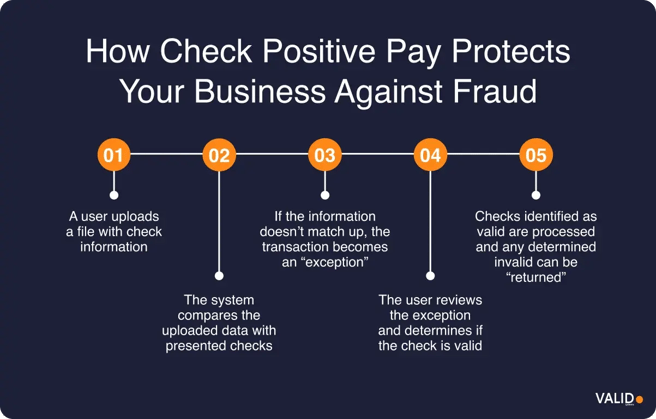
Positive Pay comes in different options, depending on the level of review control:
- Positive Pay: Matches check number and amount against the issued check file, blocking unauthorized or altered payments before they clear.
- Payee Positive Pay: Adds payee name verification to detect checks where the payee has been altered, even if the amount and check number are correct.
- Reverse Positive Pay: The bank sends the customer a list of presented checks, and the customer decides which to pay. It is ideal for smaller organizations that want more hands-on control over the process.
3. Leverage machine learning and AI for anomaly detection
With fraud becoming both more frequent and more sophisticated, manual reviews alone are no longer enough.
As a result, banks are increasingly turning to AI and machine learning, with 91% of U.S. banks using some form of AI for fraud detection as of 2025.
These technologies analyze account behavior and check activity in real time, identifying unusual patterns and flagging potential fraud before losses occur.
Why you should adopt AI:
- Behavioral analytics: AI learns what “normal” activity looks like for each account, such as typical deposit amounts, frequency, and locations, and then flags anything that deviates from that pattern. This is especially useful for detecting schemes like check kiting or mule accounts, when behavior suddenly shifts in suspicious ways.
- Image analysis: AI can examine check images for signs of forgery or tampering, such as altered fonts, inconsistent MICR lines, or reused check images. Comparing deposits to known counterfeit patterns and past transactions helps stop fraud before funds are released.
- Operational efficiency & cost reduction: AI significantly reduces the manual workload for fraud teams by automating large portions of monitoring, triage, and investigation. This lowers operational costs while allowing analysts to focus on the highest-risk, highest-value cases instead of routine alerts.
- Deposit channel risk scoring: AI can assign dynamic risk scores to each deposit channel (branch, ATM, mobile, RDC) based on historical fraud patterns, device fingerprints, and location anomalies.
Pro tip
Most legacy check fraud prevention tools are like judging a book by its cover. They only analyze the image, missing the story behind it.
VALID’s CheckDetect combines image analysis with behavioral analytics, payer–payee relationships, and cross-channel intelligence to deliver real-time fraud decisioning at the point of deposit.
Financial institutions using CheckDetect have:
- Captured up to 95% of check fraud losses
- Alerted on only 0.5% of total deposit volume, dramatically reducing noise
- Reduced false positives, allowing fraud teams to focus only on real risk
Contact us today to see how real-time, AI-driven predictive decisioning can help you reduce fraud losses.
4. Enhance teller and employee training
Front-line staff are your first line of defense and your eyes and ears on the floor.
An experienced teller can often recognize a sketchy situation before it becomes a real issue—but only if they know exactly what to look for, how to respond calmly, and when to escalate concerns to the right people.
How to train your staff:
- Teller training: Train tellers to actively check for washed amounts, inconsistent fonts, and check stock irregularities, especially on large checks from unfamiliar customers. Require them to follow a clear checklist for non-payee presentments and enforce ID verification steps, such as inkless fingerprinting or secondary approval, before cashing.
- Back-office staff training: Back-office teams should review weekly fraud trend reports and update internal alert rules as new schemes emerge, such as mail theft or counterfeit payroll checks. Use real fraud cases from your institution to demonstrate detection gaps and response improvements.
- Cross-department awareness: Every department should have a defined fraud escalation contact and a simple reporting process employees can follow in under one minute. Reinforce this with short quarterly refreshers and real examples of how past reports helped prevent losses.
- Incident response drills: Run quarterly fraud response simulations so staff can practice escalating suspicious transactions in real time, not just on paper. These drills help identify communication breakdowns and ensure employees know exactly who to contact and what steps to follow when fraud is detected.
5. Utilize check security features and fraud-resistant check stock
Financial institutions can work with customers (especially business clients) to make checks harder to tamper with.
How to do it:
- Modern check stock: Use high-security check paper for all official checks, including features like watermarks, holograms, heat-sensitive ink, and microprinting. Educate business customers that spending a little more on secure check stock can prevent costly fraud.
- Restrictive endorsements: Ask customers to use restrictive endorsements like “For deposit only to account #XXXX” and add “via Mobile Deposit” for mobile deposits. This adds a layer of protection and helps support them in the event of a dispute.
- Check serialization and duplicate control: Encourage businesses to track blank check inventory and serial numbers. Any missing checks, duplicates, or misprints should be reported or destroyed immediately to prevent fraud.
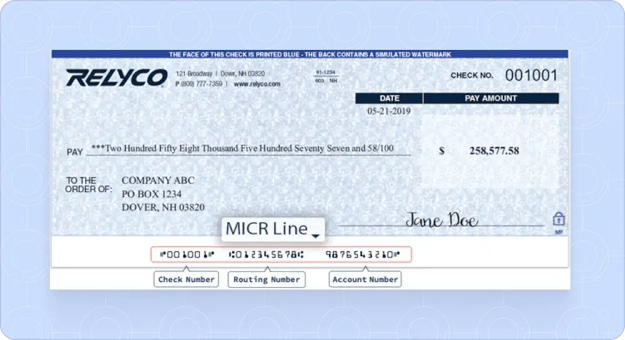
- MICR verification: Use verification tools to confirm the integrity of the Magnetic Ink Character Recognition (MICR) line on checks. Counterfeiters often use standard printers instead of true magnetic ink, and inconsistencies in font, spacing, or signal strength can quickly expose fraudulent checks.
6. Tighten internal controls and processes
Unfortunately, check fraud sometimes originates from within or results from weak controls. Make sure your internal processes aren’t leaving the door open or making it easier for fraudsters to get through.
How to prevent it:
- Segregation of duties: No single employee should have end-to-end control over a high-risk process. For example, the person who reconciles correspondent bank accounts should not also issue official checks. Also, deposit capture should use dual control, with one person scanning checks and another verifying totals, as recommended by FinCEN.
- Transaction holds & reviews: Establish rules requiring secondary review for large or unusual check and ACH transactions. Supervisor or accounting approval before posting helps catch fraud attempts that automated systems may miss.
- Fraud response plan: Create a clear, documented playbook for responding to suspected or confirmed check fraud. This should include rapid customer remediation, coordination with other banks, SAR filing within required timeframes, and law enforcement notification when appropriate.
- Inventory of official documents: Maintain strict inventory control over cashier’s checks, money orders, and other official instruments. All numbered documents must be fully accounted for, and any missing stock should be treated as a formal security incident.
Pro tip
Most fraud response plans focus on damage control. VALID’s model adds damage prevention plus financial protection.
With Instant Funds, banks can offer select customers immediate access to deposited funds, while VALID guarantees those funds against returns.
This allows your institution to:
- Speed up customer access to money
- Create a new fee-driven revenue stream
- Eliminate risk associated with early funds availability
7. Expand detection beyond internal systems
Leverage industry-wide intelligence and advanced analytics tools to strengthen your fraud detection capabilities beyond what internal systems alone can provide.
How to do it:
- Fraud data sharing consortia: Many fraudsters target multiple banks, so shared intelligence is critical. Platforms like Valid Systems’ Edge Data Consortium connect financial institutions in a secure, AI-powered network to detect fraud patterns earlier.
- Velocity and network analytics: Use network analytics to identify hidden connections between accounts, devices, and identities involved in check fraud. These relationships often expose organized fraud rings and can be visualized using link analysis features available in modern fraud detection platforms.
- Keep software updated: Ensure all fraud detection tools, including AI models and check image scanners, are consistently updated with the latest patches and fraud pattern libraries. Outdated software creates exploitable gaps that fraudsters actively exploit, allowing newer check-alteration techniques to go undetected.
Pro tip
Most fraud systems only know what’s happened inside your institution. Fraud rings know this, and that’s why they hit multiple banks at once.
VALID’s Edge Data Consortium securely pools anonymized intelligence from hundreds of millions of accounts across financial institutions.
By combining machine learning with cross-bank behavioral signals, Edge allows you to see check fraud schemes forming before they fully impact your institution, whether it’s counterfeit checks, coordinated mule networks, or account funding fraud.
Detect, prevent, and outsmart check fraud with VALID Systems
VALID Systems delivers next-generation fraud prevention solutions powered by machine learning, cross-bank intelligence, and real-time transaction scoring.
Processing over $4 trillion in annual check volume across major U.S. financial institutions, VALID provides the advanced visibility and predictive analytics needed to stay ahead of rapidly evolving fraud threats.
Why should you choose VALID:
- CheckDetect – Stop check fraud before it happens with AI-powered, real-time deposit analysis that blocks over 75% of potential charge-offs.
- InstantFUNDS – Deliver sub-second deposit decisions, accelerate up to 99% of approvals, guarantee covered losses, and unlock new fee revenue.
- CheckDetect Inclearing – Detect fraud during the clearing cycle with advanced ML, reducing false positives and minimizing operational review burden.
- Edge Data Consortium – Strengthen defense through cross-bank intelligence using a secure, AI-powered fraud prevention network.
- VALID Insights Portal – Gain actionable, real-time insights through behavioral analytics, predictive ML decisioning, and intuitive dashboards.
- Financial Health Score – Understand customer financial wellness in real time using behavior-driven analytics to personalize products and reduce risk.
Schedule a consultation to see how VALID’s AI-powered fraud prevention helps you stop check fraud!