

As banks and financial institutions accelerate their digital transformation, the need for robust and reliable identity verification has never been greater.
Traditional single-factor authentication methods are no longer sufficient to defend against increasingly sophisticated fraud and cyber threats. That is why an increasing number of organizations are adopting advanced, layered approaches that combine multiple biometric identifiers for stronger protection.
In this article, we explain what you need to know about multimodal biometric authentication and why it is becoming the future of digital security in the financial sector.
Key takeaways
- Multimodal biometrics dramatically raise the security bar
Verifying identity with two or more biometric traits makes cyber attacks far harder to execute. Even if one signal is compromised, the remaining layers continue to protect access, reducing the chance of fraud and unauthorized entry.
- Accuracy and reliability improve when biometrics work together
Combining modalities offsets the weaknesses of any single method. Research consistently shows multimodal systems achieving near-perfect accuracy with much lower error rates, meaning fewer false rejections for real users and fewer false approvals for attackers.
- User experience and accessibility are stronger than with single biometrics
Multimodal systems adapt to real-world conditions, such as injuries, disabilities, or poor lighting, by offering alternative authentication methods. This flexibility supports broader user populations without sacrificing security.
- Implementation requires planning beyond just technology
While the benefits are clear, organizations must account for higher upfront costs, system complexity, privacy regulations, and user trust. Success depends on careful biometric selection, secure data handling, and thoughtful user-centered design.
- Authentication alone is not enough; real-time fraud prevention completes the picture
Even the strongest biometric login cannot prevent fraud after access is granted. VALID extends protection beyond authentication by analyzing behavior, transactions, and network risk in real time, helping financial institutions stop fraud during high-risk moments without adding friction.
What is multimodal biometric authentication?
Multimodal biometric authentication is an advanced security approach that verifies a person’s identity using two or more biometric identifiers. These identifiers can include:
- Facial recognition
- Fingerprints
- Iris or palm scans
- Voice patterns
This layered approach makes it much harder for attackers to fake or bypass authentication.
Unimodal vs. multimodal biometric systems: Key differences
The following comparison outlines the key differences across performance, security, and implementation factors between unimodal vs. multimodal biometric systems:
|
Category |
Unimodal systems |
Multimodal systems |
|
Level of Protection |
Offers a basic level of security and is more vulnerable to imitation attacks |
Provides robust security through multiple verification layers |
|
Verification Reliability |
Performance depends on one biometric input |
Reliability increases by combining several biometric traits |
|
Error Handling |
Limited ability to recover from recognition errors |
Reduced failure rates due to alternative validation methods |
|
User Accessibility |
Supports a single form of biometric input |
Accommodates a wider range of users and conditions |
|
Cost Considerations |
Lower deployment and maintenance costs |
Higher initial costs with stronger long-term benefits |
|
Attack Resistance |
Susceptible to focused exploitation |
Highly resistant due to multi-layered authentication |
Benefits and challenges of multimodal biometric authentication
While multimodal biometric authentication offers significant improvements in security, accuracy, and user flexibility, it also introduces new technical and organizational considerations. Understanding both the benefits and challenges of this approach is essential for evaluating its effectiveness and overall suitability.
Benefits:
- Stronger protection against fraud: Using multiple biometric checks makes it much harder for attackers to gain unauthorized access. Even if one method is compromised, the remaining layers continue to protect the system.
- More accurate authentication results: Research on systems combining facial and iris recognition showed that individual modalities achieved 95–96% accuracy, while the multimodal system reached nearly 100% accuracy with an equal error rate (EER) of 0.26%.
- Better accessibility for all users: Offering multiple authentication methods lets users choose the one that works best for them. This is especially helpful when injuries, disabilities, or environmental conditions make a certain biometric option inefficient.
- Designed for large-scale deployment: Multimodal biometric systems can support large numbers of users across multiple locations without losing performance. They also allow organizations to expand and adopt new biometric technologies without rebuilding their entire security framework.
Challenges:
- Higher initial costs: Multimodal biometric systems often require greater upfront investment due to additional sensors, software, and infrastructure upgrades. Organizations must balance these costs against long-term benefits such as reduced fraud and improved operational efficiency.
- Technical complexity: Using multiple biometric technologies increases system complexity and requires careful coordination among hardware, software, and data-processing components. Without proper planning and expertise, integration issues can lead to performance inconsistencies and deployment delays.
- Compatibility with existing systems: Older IT and security infrastructures may not support advanced biometric solutions. Integrating multimodal authentication often requires system upgrades or transitional solutions to avoid operational disruption.
- Privacy and regulatory requirements: Biometric data is highly sensitive and subject to strict privacy laws in many regions. Failure to comply with data protection regulations can result in legal penalties, financial losses, and damage to organizational trust.
- User trust and ethical concerns: Some users are hesitant to adopt biometric authentication because of privacy concerns or cultural perceptions of how biometric data is used. In fact, studies show that about 21% of people feel uncomfortable with their biometric data being collected. Building acceptance requires transparency, clear communication, and access to alternatives.
The biometrics behind multimodal authentication
Choosing the most effective approach depends on factors such as security needs, user demographics, and the operational setting. Below are the key biometric methods commonly used in biometric-based authentication systems.
1. Fingerprint recognition
Fingerprint recognition verifies identity by scanning the unique ridge patterns on a person’s fingertips using optical, capacitive, or ultrasonic sensors and comparing them to stored records. Studies show that modern fingerprint systems achieve over 98% authentication accuracy, with false acceptance rates as low as 0.01%.
2. Facial recognition
Facial recognition identifies individuals by analyzing distinctive facial features such as eye spacing, nose shape, and jaw contours, often enhanced by 3D depth mapping and infrared sensing to prevent spoofing.
According to evaluations by the US National Institute of Standards and Technology (NIST), leading facial recognition systems achieve at least 99.87% accuracy in one-to-one identity verification tests.
3. Voice recognition
Voice recognition verifies identity by analyzing unique vocal traits, such as pitch, tone, and speech patterns, to create a voiceprint that matches a person to stored records.
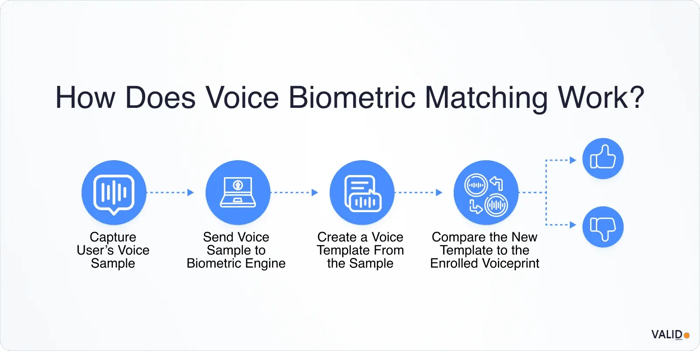
Studies indicate that well-implemented voice biometric systems can achieve an accuracy of up to about 98% under controlled conditions.
4. Behavioral biometrics
Behavioral biometrics monitors how people interact with devices, such as typing rhythm, mouse movement, and gesture patterns, to continuously verify identity and help detect suspicious activity during a session.
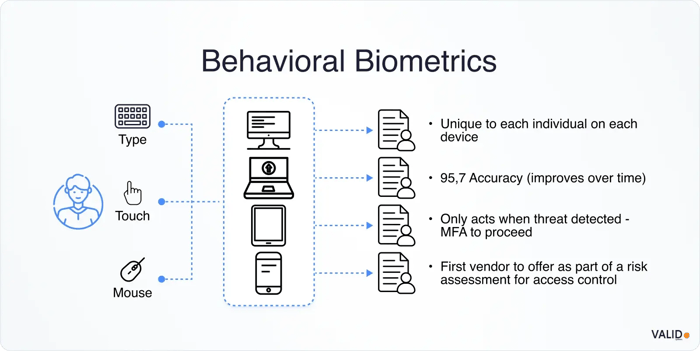
Studies show that these systems can achieve around 95.7% accuracy in authenticating users after just 30 seconds of interaction.
5. Iris and retinal scans
Iris and retinal scans verify identity by capturing unique eye features, including the detailed patterns of the iris and the blood vessel structures within the retina, which remain highly stable over time.
Iris recognition systems can achieve accuracy rates above 99% with false acceptance rates as low as 1 in 1.2 million, making these technologies well-suited for high-security environments where maximum precision is required.
Fusion levels in multimodal biometric systems
Fusion techniques define how information from multiple biometric modalities is combined to reach an authentication decision. The selected fusion level influences system accuracy, computational complexity, and implementation feasibility.
|
Fusion level |
Description |
|
Sensor-level fusion |
Combines raw biometric data from multiple sensors before feature extraction. Although it preserves the maximum amount of information, it is rarely used due to strict data compatibility requirements and high computational complexity. |
|
Feature-level fusion |
Merges extracted feature vectors from different biometric modalities into a single representation. This approach can improve recognition accuracy but requires careful feature normalization and alignment. |
|
Score-level fusion |
Integrates matching scores produced independently by each biometric modality. It offers a strong balance between accuracy and implementation feasibility, making it the most widely adopted fusion method. |
|
Decision-level fusion |
Combines final accept-or-reject decisions using logical rules or voting strategies. While simple to implement, it discards detailed matching information and generally provides lower accuracy than other fusion levels. |
Best practices for multimodal biometric authentication
Deploying multimodal biometric systems effectively involves more than selecting the right technologies. The following best practices focus on planning, usability, and long-term system operation.
1. Choose the best biometric combination
Select biometric modalities that align with your security goals, user population, and operating environment. Take into account factors such as:
- Required accuracy
- Environmental conditions
- User acceptance
- Budget constraints
Running pilot tests with representative user groups can help identify strengths and limitations before committing to full deployment. Here are the most popular combinations you can try:
|
Combination |
Reason for pairing |
Main advantage |
|
Facial + Fingerprint |
Combines a non-contact biometric with a high-precision physical trait, reducing dependence on environmental conditions |
Improved robustness and lower false rejection rates |
|
Facial + Iris |
Uses complementary facial structure and highly distinctive iris patterns |
Very low error rates suitable for high-security systems |
|
Fingerprint + Voice |
Integrates a stable physical biometric with a behavioral vocal trait |
Enables secure authentication in both in-person and remote scenarios |
|
Behavioral + Physical (Face or Fingerprint) |
Pairs continuous behavioral monitoring with an initial physical identity check |
Ongoing identity verification during active sessions |
|
Iris + Fingerprint |
Combines two highly stable and unique physiological traits |
Maximum resistance to spoofing and impersonation |
2. Secure biometric data and systems
Biometric data requires stronger protection than traditional credentials because it cannot be changed once compromised. To reduce risk in real deployments, you can:
- Encrypt biometric templates using strong, standardized encryption (e.g., AES-based methods) both in storage and during transmission
- Store only protected biometric templates, not raw biometric images or recordings
- Separate biometric databases from application and user data to limit damage if a system is breached
3. Focus on user experience
Multimodal biometric systems must be easy to use in everyday situations. A poorly designed experience can lead to user frustration, errors, and reduced adoption.
Here is a set of design considerations that help improve usability without compromising security:
- Keep authentication steps short and avoid unnecessary repeated checks.
- Provide clear, simple guidance during enrollment and verification.
- Design error messages that explain what went wrong and how to retry.
- Ensure alternative options are available for users with disabilities or temporary limitations.
4. Monitor performance and security risks
Biometric systems must be actively monitored to remain secure, reliable, and effective over time. Here is how you can identify emerging issues early and allow systems to respond to new security threats:
- Track authentication success rates and error rates to identify changes in system accuracy.
- Monitor system performance metrics to detect delays, failures, or resource constraints.
- Analyze system logs and usage patterns to identify abnormal behavior or potential attacks.
- Review monitoring data regularly to detect gradual performance degradation.
Strengthen multimodal biometric authentication with VALID
While multimodal biometric authentication represents a powerful advancement in identity verification, banks and financial institutions face a broader challenge: Fraud does not stop at login.
Even the most secure authentication frameworks must be paired with intelligent, real-time risk decisioning to protect transactions after access is granted.
This is where VALID Systems plays a critical role.

VALID complements biometric and identity-based security strategies by monitoring behavioral patterns, transactional context, and payer–payee relationships in real time.
Instead of relying on static rules or single-signal analysis, VALID’s platform evaluates multiple risk signals simultaneously, enabling banks to stop fraud without introducing customer friction.
For financial institutions deploying or planning multimodal biometric authentication, VALID extends protection beyond identity verification by:
- Detecting fraud during high-risk moments, such as check deposits, instant funds availability, and clearing cycles
- Reducing reliance on manual reviews, even as transaction volumes scale
- Preserving customer trust by minimizing unnecessary holds and false positives
- Adapting machine learning models that evolve with emerging fraud patterns
By combining behavioral analytics, network intelligence, and machine learning-driven risk scoring, VALID enables banks to:
- Approve up to 99% of deposits in real time
- Reduce fraud losses by up to 87%
- Cut manual review workloads by 74%
- Guarantee covered losses on eligible transactions
Contact us today to reduce fraud, accelerate approvals, and strengthen multimodal biometric protection across every transaction.
FAQ:
1. Is multimodal authentication more secure than single biometrics?
Yes. Multimodal authentication is significantly more secure because it requires multiple biometric traits to be verified at the same time.
This makes attacks far more difficult, since compromising several biometrics together is much harder than spoofing just one.
2. Will using multiple biometrics slow down the login experience?
No. Modern multimodal systems process biometrics simultaneously, allowing users to authenticate in seconds. In many cases, they reduce friction by removing passwords and offering seamless fallback options when one biometric doesn’t work.
3. How is multimodal biometric authentication different from multi-factor authentication?
Multimodal biometric authentication uses multiple biometric traits (like face and fingerprint) to strengthen a single identity factor: who you are.
Multi-factor authentication combines multiple factors, such as passwords, devices, and biometrics, to provide additional layers of protection.