

Did you know that financial institutions generate millions of transaction records every day from payments, transfers, loans, and account activity?
On their own, these records are simply operational data, but together they tell a much larger story about customer behavior, risk, and performance.
By analyzing this data, you can turn this raw activity into actionable insight used across fraud detection, compliance monitoring, and financial planning.
In this article, we will explain what transactional data analysis is, share real-world examples, and explore its most important use cases.
Key takeaways
- Transactional data reveals how customers actually behave, not just who they are
Analyzing detailed records of purchases, transfers, deposits, withdrawals, and payments gives banks a clear, behavior-driven view of how customers manage money, going far beyond basic demographics or account balances.
- Most banking analytics value comes from a few high-impact use cases
Fraud and AML, credit risk and lending, personalized marketing, and operational efficiency account for the majority of transactional data analytics impact, directly influencing revenue growth, loss prevention, and customer experience.
- Real-world examples show measurable financial and operational impact
Banks and credit unions are using transaction analytics to reduce fraud, optimize staffing, refine pricing strategies, and increase revenue, often seeing improvements within months rather than years.
- Data challenges are the main barrier, not a lack of opportunity
Legacy systems, data silos, quality issues, privacy requirements, and talent gaps often slow adoption. Successful institutions focus on tools that integrate easily, scale in real time, and embed security and compliance from day one.
- Modern, real-time platforms unlock the full value of transactional data
The greatest value comes when insights lead to immediate action. VALID enables real-time transaction scoring and behavioral analytics at scale, helping financial institutions reduce risk, improve efficiency, and confidently act on insights as transactions occur.
What is transactional data analysis?
Transactional data analysis examines detailed financial transaction records to uncover meaningful insights about customer behavior and operations.
Each transaction, such as a purchase, transfer, deposit, or payment, creates a data trail that includes details such as:
- Time
- Amount
- Location
- Accounts
- Parties involved
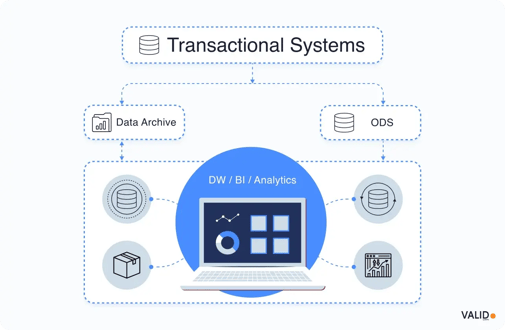
By analyzing these digital footprints, banks and credit unions can identify patterns and trends that support smarter decisions, improve services, and manage operations more effectively.
Different types of transactional data
Transactional data in banking comes from a variety of day-to-day customer activities. It primarily covers financial transactions, which can be grouped into a few core categories:
- Purchases: Purchase transactions occur when customers use their accounts or cards to buy goods or services. These include in-person credit or debit card swipes at physical merchants as well as online and mobile purchases made through digital platforms.
- Transfers: Transfer transactions involve moving money from one account to another. This can include internal transfers between a customer’s accounts, wire transfers to external banks, or peer-to-peer payments via digital payment services.
- Deposits: Deposit transactions represent funds being added to a customer’s account. Common examples include payroll deposits, checks deposited at a branch or via a mobile app, and cash deposits at ATMs or at a bank teller.
- Withdrawals: Withdrawal transactions occur when funds are removed from an account. These include cash withdrawals from ATMs, over-the-counter cash withdrawals at branches, and electronic debits that reduce an account balance.
- Payments: Payment transactions involve customers using their funds to settle financial obligations. This category includes credit card bill payments, loan and mortgage payments, utility bills, and other recurring or one-time payments made to service providers.
Beyond recording the monetary amount, each transaction typically includes rich contextual information that, when aggregated, provides deep insight into customer financial behavior. Below are the key components and characteristics typically included in transactional data records:
- Standardized fields such as transaction date, time, amount, and account identifiers are used to ensure consistency and accuracy across all records.
- Contextual information may capture where and how the transaction occurred, including the location, channel used (ATM, branch, mobile app), and the merchant or counterparty involved.
- Transaction metadata, such as transaction type, category, or payment method, helps classify activities and support detailed financial analysis.
- Aggregated transaction histories allow banks to analyze patterns over time, providing insight into customer spending habits, cash flow, and overall financial behavior.
- A focus on financial exchanges distinguishes transactional data from other banking data, as it primarily records monetary activities rather than non-financial events like logins or service interactions.
Examples of transactional data analysis in action
To illustrate how transactional data analysis translates to real-world outcomes, here are a few examples of US financial institutions leveraging it:
1. US bank: Reducing customer churn and increasing revenue
A US bank applied machine learning to analyze its large volume of transactional data and better understand customer behavior.
The analysis focused on how relationship managers were using fee waivers and special discounts, which were assumed to be granted only to high-value customers.
The findings challenged that assumption:
- Discounts were often given unnecessarily
- Many of these concessions did not increase customer loyalty
- In some cases, they simply reduced revenue without adding value
Armed with these insights, the bank updated its pricing strategy and clarified employee guidelines. Within a few months, revenue rose by 8%, driven by the reduction in unnecessary discounts.
2. Bank of America: Fraud detection and security at scale
Bank of America, one of the largest banks in the United States, has made significant investments in AI-driven transaction analysis to fight fraud at scale.
The bank combines data from multiple channels into a single, real-time monitoring system, including ATM withdrawals, credit card purchases, and online and mobile banking transactions.
Using historical transaction data, Bank of America trains machine learning models to recognize normal customer behavior. When a transaction doesn’t fit expected patterns, the system can:
- Flag suspicious activity instantly
- Halt or review payments before they are completed
- Prevent fraud before financial damage occurs
The impact has been substantial. Fraud detection now operates continuously, 24/7, and the number of fraudulent transactions has dropped significantly.
3. ORNL Federal Credit Union: Optimizing branch operations
ORNL Federal Credit Union in Tennessee launched a transaction data analysis project to better understand how and when members use its services. The credit union analyzed transaction activity by:
- Visualizing member transactions across branches, channels, and times of day
- Creating a “transaction heat map” to highlight usage patterns
- Identifying peak periods and slower, underutilized hours
These insights enabled ORNL FCU to:
- Adjust branch staffing in near real time
- Shift tellers and staff between slow periods and peak demand
- Better align employee schedules with member traffic
The impact was felt quickly. Within months, members experienced shorter wait times during busy hours, while the credit union made more efficient use of its staff.
Transactional data analysis use cases
Financial institutions apply transactional data analysis in many areas of their business. Below are some of the most impactful use cases, along with short descriptions of how they create value:
1. Fraud detection and anti-money laundering (AML)
Fraud detection and anti–money laundering (AML) systems, which represent about 25% of banking analytics use cases, analyze transactions in real time to quickly identify suspicious activity.
Algorithms flag unusual patterns, such as rapid out-of-state purchases, transfers that don’t match a customer’s profile, or card use in two countries within an hour, helping prevent losses.
2. Credit risk scoring and lending decisions
Credit risk scoring and lending decisions, which account for about 30% of banking analytics use cases, use transaction data alongside traditional credit scores to better assess borrower risk.
By analyzing patterns, such as deposit consistency, spending behavior, and savings activity, banks can more accurately assess default risk, expand access to credit for qualified borrowers, and maintain stronger loan performance.
3. Personalized marketing and customer insights
Roughly 20% of banking analytics use cases focus on personalized marketing and customer insights, leveraging transaction data to understand customer behavior and preferences.
By analyzing spending patterns across channels, banks can segment customers, identify the next best product, and deliver timely, relevant offers that improve the customer experience while increasing loyalty and engagement.
4. Operational efficiency and planning
About 15% of banking analytics use cases focus on operational efficiency and planning, using transaction data to streamline processes and reduce costs.
By analyzing internal transaction flows, such as ATM usage, call center demand, loan processing times, and payment routing, banks can identify bottlenecks, respond to issues in real time, and uncover efficiencies that lead to faster operations and meaningful cost savings.
5. Regulatory compliance and reporting
About 10% of banking analytics use cases focus on regulatory compliance and reporting, relying on transaction data to meet strict oversight and reporting requirements.
By using analytics to automatically monitor, aggregate, and report on millions of transactions in real time, banks can:
- Detect compliance issues faster
- Avoid regulatory penalties
- Demonstrate stronger control environments
- Unlock additional business insights from the required data
Challenges of transactional data analysis
Banks can gain powerful insights from transaction analytics, but adopting these capabilities is not without obstacles.
The following challenges highlight the key barriers financial institutions must address to successfully leverage their data:
- Data integration and legacy systems: Many banks rely on outdated systems that store data in separate silos, making it hard to see a complete picture of customer activity. Bringing data together from multiple sources often requires costly system upgrades and significant IT effort.
- Data privacy and security concerns: Transaction data contains highly sensitive personal information, so banks must follow strict privacy laws and protect against cyberattacks. Strong security controls are essential, but they can also slow down analytics projects if not carefully planned.
- Data quality and accuracy issues: Banks often encounter inconsistent, incomplete, or duplicate transaction data, which can lead to unreliable insights. Cleaning and standardizing data before it can be used confidently can take significant time and effort.
- Analytics talent and culture gap: Advanced transaction analytics requires specialized skills that are in short supply across the banking industry. At the same time, shifting from traditional decision-making to a data-driven culture can be challenging for staff and leadership.
- Ethical and regulatory compliance: Banks must use transaction data responsibly while complying with complex and evolving regulations. Balancing innovation with fairness, transparency, and legal requirements can limit how quickly and creatively data is used.
How to choose the best transactional data analysis tool
Choosing the right transactional data analysis tool is critical for turning high-volume, high-velocity financial data into actionable insights while meeting security and compliance requirements.
The best tools balance analytical power, scalability, and ease of integration with existing banking systems. Here is what to look for:
- Scalability and performance: Ensure the tool can process millions of transactions in near real time without performance degradation.
- Advanced analytics and AI capabilities: Focus on support for machine learning, anomaly detection, and pattern recognition to enable fraud detection, risk scoring, and customer insights.
- Data integration and compatibility: The tool should integrate easily with core banking systems, data warehouses, and multiple transaction channels.
- Security and compliance: Strong encryption, access controls, and built-in support for regulatory requirements (e.g., AML, reporting) are essential.
- Usability and visualization: Intuitive dashboards, flexible reporting, and visualization features help both technical and business users quickly extract value.
- Cost and flexibility: Consider total cost of ownership, deployment options (cloud vs. on-premises), and the ability to adapt as business needs evolve.
Transform transactional data analysis into action with VALID Systems
Transactional data analysis delivers its greatest value when insights can be acted on in real time, especially in high-risk, high-volume environments like check deposits and payments.
Many financial institutions still rely on outdated systems and manual reviews, but modern platforms now turn transactional data into real-time, actionable decisions.
This is exactly where VALID can help you!
Why you should consider VALID
VALID’s platform is purpose-built around real-time transaction scoring, behavioral analytics, and machine learning, core capabilities required for effective transactional data analysis in today’s banking environment.
Key strengths include:
- Real-time transaction decisioning: VALID evaluates transactions at the moment of presentment, enabling immediate decisions without slowing customer workflows.
- Behavioral and relational analytics: Rather than relying solely on static rules or image analysis, VALID analyzes depositor behavior, payer patterns, velocity, and network relationships to unlock deeper insights from transactional data.
- Scalability at banking volumes: With hundreds of millions of accounts decisioned and trillions of dollars in deposits processed annually, VALID demonstrates the ability to analyze transactions at enterprise scale.
- Embedded risk reduction: Guaranteed funds and loss coverage models allow financial institutions to act confidently on analytics-driven decisions without increasing risk exposure.
- Edge data consortium intelligence: Edge extends transactional data analysis beyond a single institution by securely sharing anonymized fraud signals across banks and credit unions to detect emerging fraud patterns earlier.
Turn your transactional data into real-time decisions. Contact us today and see how VALID helps banks and credit unions reduce risk, increase efficiency, and unlock smarter insights at scale.