

Biometric authentication is here to stay. The global biometrics market was valued at $60 billion in 2025 and is projected to exceed $307 billion by 2034. Adoption is increasing, and most clients and regulators today expect this method to be offered.
There are many advantages of biometrics. This technology enhances security and fraud prevention while streamlining verification for you and your clients. Still, it can also introduce privacy risks and operational complexities.
This article examines the benefits and drawbacks of implementing biometric technology to help you evaluate whether it’s right for your institution.
Key takeaways
- Biometrics strengthen security
Criminals can guess, steal, or purchase passwords and PINs. Biometric authentication relies on unique physical or behavioral traits that are difficult to replicate, which helps reduce account takeovers and synthetic identity fraud.
- Biometrics’ advantages extend beyond security
Biometrics help meet authentication requirements, such as KYC and AML, and generate audit-ready verification logs. They also reduce manual review workloads, cut customer acquisition costs, and eliminate friction for customers.
- Implementation comes with challenges
Biometric data is highly sensitive and can’t be reset, which makes it a prime target for criminals. While accuracy is high, it’s not perfect, and can vary across demographic groups. Implementation can be resource-intensive, as upfront costs are significant and privacy regulations are strict and complex.
- The future lies in responsible biometrics
Advancements in biometric systems will focus on reducing bias and prioritizing privacy and accessibility. Technologies such as multimodal systems, AI-driven detection, and self-sovereign identity are gaining traction.
- VALID Systems secures what happens after authentication
Biometrics confirm identity at login, but they cannot stop fraudulent deposits, mule accounts, or bad checks. VALID’s real-time decisioning platform analyzes every transaction as it occurs, catching threats that identity verification alone will miss.
What are biometrics?
Biometrics refers to the method of verifying a client’s identity by measuring and analyzing their unique biological or behavioral characteristics. Common examples include fingerprints, facial features, voice patterns, and irises.
You can use biometric authentication to verify a client’s data against an existing reference or confirm their identity from a database of users.
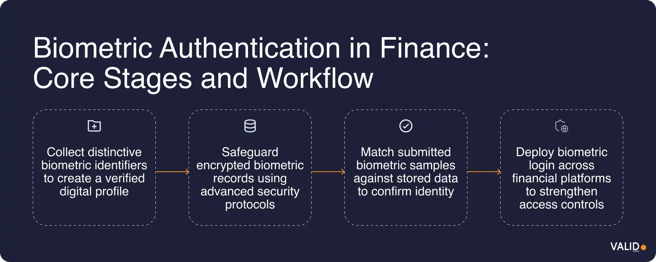
The authentication process usually goes as follows:
- You capture the client’s biometric features to create an encrypted reference.
- The client provides a live sample when you request to verify their identity.
- The sample is converted into a digital, encrypted template.
- The system compares the sample and the reference, then provides a similarity score.
- The score determines whether the system authorizes the action.
- In case of rejection, the system prompts further action, such as manual review or secondary verification.
Types of biometrics in identity verification
Here’s a brief overview of biometric authentication methods in financial services:
|
Type |
Biometric method |
What it analyzes |
What it’s commonly used for |
|
Physical |
Fingerprint scan |
Ridge pattern on the fingertip’s surface |
|
|
Facial recognition |
Distance between different features |
|
|
|
Iris scan |
Patterns in the structure of the colored part of the eye |
|
|
|
Palm and finger scan |
Vein patterns that appear in the palm and fingers via infrared light |
|
|
|
Voice recognition |
Pitch, tone, cadence, and speech patterns |
|
|
|
Behavioral |
Signature recognition |
Writing pressure, speed, and stroke order |
|
|
Digital behavior patterns |
IP address, rhythm and speed of typing, scrolling behavior, and mouse movements |
|
The advantages of biometrics
In 2025, 87% of global banks used biometric authentication. Here’s why:
1. Stronger security and fraud prevention
In 2024, nearly 30% of adults experienced account takeover. Passwords and PINs are often weak links in security systems; criminals can steal them through phishing, guess them, or purchase them on the dark web.
The clients are not the only ones at loss, either, since financial institutions often have to cover reimbursements and deal with reputational damage.
Biometrics address this vulnerability directly. Biological traits like fingerprints and facial structure are unique to each individual and difficult to replicate. Because of that, they offer a level of authentication that knowledge-based methods can never match, especially when multi-factor is enabled.
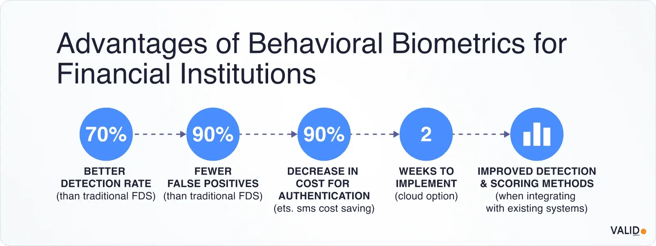
Biometric systems also help identify fraud in real time. For example, behavioral analytics help you detect unusual activity and receive alerts so you can respond quickly and minimize damage. They significantly improve detection rates and reduce false positives.
Based on KPMG’s 2023 analysis, participating institutions reported a 66% reduction in account takeover within 12 months of adopting multimodal biometric authentication. In another study, institutions saw an average 35.5% reduction in fraud after implementing behavioral biometrics.
2. Regulatory compliance
Financial institutions face strict identity verification requirements under Know Your Customer (KYC) and Anti-Money Laundering (AML) regulations. In the European Union, the revised Payment Services Directive (PSD2) mandates strong customer authentication for payment services.
Biometric verification provides reliable, tamper-resistant proof of identity that withstands regulatory scrutiny. It also generates secure verification logs that demonstrate compliance during audits. For institutions operating across jurisdictions, biometric systems can help meet regional standards by providing a single authentication framework.
3. Improved client experience
In Aware’s 2024 survey, nearly 50% of participants claimed to use biometric authentication “often” or “always” to log in to mobile apps. An older Visa study also indicates that many clients would switch banks if their current provider failed to offer biometric authentication.
Apart from enhancing account security, biometric login eliminates the frustration of forgotten passwords and clunky security questions. Clients can access accounts, authorize transactions, and complete onboarding in seconds rather than minutes. This speed reduces abandonment rates during sign-up and improves overall satisfaction with banking services.
4. Operational and cost-efficiency
Biometrics also delivers measurable operational savings. Digital identity verification systems can reduce customer acquisition costs from $280 per customer to $120, though the figure can go down to $19 over time.
These savings compound across the organization. Automated biometric verification reduces the volume of manual identity checks, and call centers spend less time on password resets and identity verification questions.
As fraud declines, the resources previously dedicated to investigating and mitigating incidents can be redirected.
The disadvantages of biometrics
Before implementing biometric systems, consider the following challenges:
1. Privacy and data protection risks
Biometric data is highly personal and sensitive, and it cannot be reset. The client can’t generate a new fingerprint if compromised in a breach. This permanence makes biometric databases high-value targets for attackers and raises the stakes for any security failure.
Customers are aware of this risk. In the Identity Theft Resource Center’s 2024 survey, 69% of respondents reported worrying that their data could be compromised by insiders.
Many hesitate to share biometric data without clear explanations of how that information will be stored, who can access it, and how it might be shared. Banks that fail to communicate their data protection practices transparently may face resistance during enrollment.
2. Implementation costs and challenges
Biometric systems require substantial upfront investment. For example, face recognition software, which is among the most expensive in the industry, can range from $20,000 to over $150,000.
In addition to software costs, you need to account for implementation and maintenance expenses. Staff training, system integration, vendor management, and continuous updates to stay ahead of evolving threats can add up and strain budgets, especially for smaller institutions.
Additionally, some clients may resist adoption due to a lack of trust, accessibility issues, or limited access to technology, so providing alternatives is essential.
3. Spoofing and emerging attack vectors
Despite reducing fraud, biometric systems are not immune to it. Attackers have successfully bypassed authentication using silicone replicas of fingerprints, high-resolution photographs, and recorded voice samples.
More recently, AI-generated deepfakes have introduced a new category of threat, with synthetic videos and audio that can fool systems lacking advanced liveness detection.
While countermeasures like 3D fingerprint imaging, pulse detection, and AI-powered presentation attack detection (PAD) are improving, they also add complexity and cost. Institutions must continuously invest in upgrades to stay ahead of attackers who are equally motivated to find workarounds.
4. Accuracy limitations and biases
Most biometric technologies today are 97.5–99% accurate, but they aren’t perfect. Poor lighting, background noise, facial obstructions, aging, and physical changes can pose challenges for the system. False positives grant access to unauthorized users, while false negatives lock out legitimate customers.
Bias presents an additional concern. Biometric algorithms trained on non-representative datasets may perform inconsistently across demographic groups, leading to higher error rates among certain populations.
To address these shortcomings, you should seek technology that is certified for fairness. The certification labs should be accredited by the National Institute of Standards and Technology (NIST) and the National Voluntary Laboratory Accreditation Program (NVLAP).
5. Legal and regulatory considerations
Biometric data is subject to strict legal protections, such as the Gramm-Leach-Bliley Act (GLBA) in the US and the General Data Protection Regulation (GDPR) in Europe. Laws vary by jurisdiction, but they all require strict controls and transparency around data collection, protection, and sharing.
If you operate across multiple jurisdictions, navigating regulations will demand significant resources. Non-compliance could result in severe financial and legal consequences.
Future of biometrics in banking
Biometric authentication is expected to evolve significantly in the next few years.
Multimodal systems that combine multiple biometric methods are gaining traction—as are newer approaches such as behavioral pattern analysis and vein and gait recognition. At the same time, AI-powered systems are becoming more sophisticated at detecting spoofing attempts while reducing false positives.
There’s also a push toward responsible biometrics. Institutions are increasingly prioritizing:
- Data privacy
- Bias mitigation
- Features that accommodate customers with disabilities
- Technology enabling biometric authentication on older devices
One development worth watching is Self-Sovereign Identity (SSI), which allows clients to store their credentials locally in a secure digital wallet rather than in the bank’s database. To authenticate the user, the wallet sends a cryptographic proof confirming their identity without revealing or exposing biometric data.
This approach offers greater privacy and convenience for clients while reducing data storage liability for institutions.
VALID Systems: Banking security beyond biometrics
Biometrics can confirm a customer's identity at login. But once that customer is authenticated, what protects against the fraudulent check they deposit, the mule account they fund, or the stolen payee information they use?
VALID addresses this gap and secures every deposit, transfer, and account action in real time.
VALID’s platform analyzes transactions as they happen, combining behavioral analytics, payee and payer relationships, and intelligence from a consortium of major financial institutions. The result is fraud detection that catches threats immediately, not in a next-day report.
How VALID strengthens your defenses:
- Edge Data Consortium connects your institution to fraud signals from 420 million accounts and $4 trillion in annual transaction volume. Coordinated attacks and cross-bank schemes become visible before they reach your customers.
- Inclearing Loss Alerts uses advanced machine learning and behavioral analytics to detect suspicious activity during the check clearing process. This advanced method improves accuracy and security while reducing operational burden.
- CheckDetect scores every deposited check in real time across mobile, ATM, and branch channels. Risk signals surface instantly, helping teams prioritize high-severity cases while reducing unnecessary holds for legitimate customers.
- InstantFUNDS delivers sub-second deposit decisions with guaranteed loss coverage, which offer immediate fund availability without absorbing additional risk.
Contact VALID Systems and use real-time fraud intelligence to protect your institution where biometrics stop.